

|
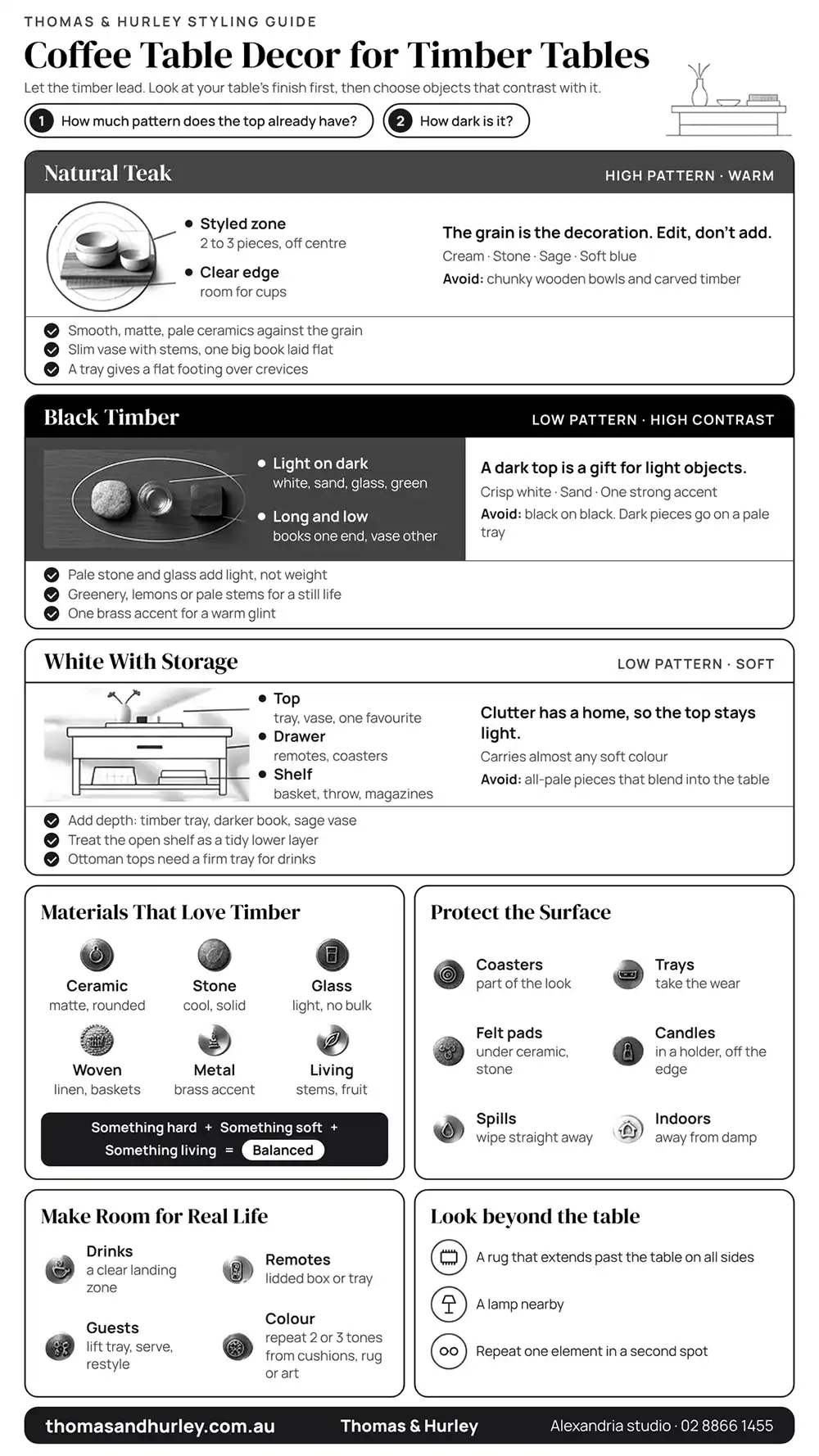
How do you decorate a timber coffee table? Let the timber lead. Look at your table's finish first: natural teak already carries plenty of pattern, black timber acts as a dark backdrop, and white paint is soft and light. Then choose objects that contrast with it, such as smooth pale ceramics on teak, light stone and greenery on black, and layered textures on white. Keep the pieces on a tray, use coasters, and leave part of the top free for everyday life. |
Timber coffee tables have a way of taking over a room, in the best sense. Grain, knots and warm tones give them a presence that a glass or laminate top rarely has, and that is exactly why generic styling advice can fall flat. A stack of books and a vase that look wonderful on a pale painted table can disappear on dark timber, or fight with a heavily patterned top. Good coffee table decor starts with the table in front of you.
This guide looks at coffee table decor through the finish of the table itself: natural teak, black timber and white painted storage tables, using pieces from the Thomas & Hurley range as working examples. We cover what suits each finish, which materials sit well with timber, how to choose a colour palette, how to protect the surface, and how to keep the table useful when the room is full of people.
1. Why Timber Tables Need Their Own Approach
In most living rooms the coffee table is the heaviest object in the middle of the space, and timber adds to that weight. The colour is warm, the grain is busy, and the surface is rarely a blank canvas. That is a good thing, because a well-made timber table already does much of the decorating for you. Your job is mostly editing.
Two questions make the editing easier. First, how much pattern does the top already have? A table with visible rings and natural crevices needs quieter objects than a smooth painted top. Second, how dark is it? A very dark table swallows dark objects, while a pale one can make light objects look washed out. Once you know the answers, the choice of tray, vase and bowl becomes far more obvious.
It also helps to know the scale you are working with. The Thomas & Hurley coffee tables range from a compact 100 cm round to a generous 129 cm oval, so the amount of styling that suits one will not suit another. We will use the dimensions of each table as we go.
2. Reading Your Table's Finish Before You Style It
Stand back and look at the table in daylight before you place anything on it. You are looking for three things: colour, pattern and sheen.
Natural teak. The Maki Round Teak Log Trunk Coffee Table, the Leni Round Teak Log Trunk Coffee Table and the Monument Rectangle Teak Log Trunk Coffee Table are all built from arranged sections of solid teak. Expect warm tones, concentric rings on the exposed end-grain, and natural variation between one piece and the next. This is a high-pattern surface.
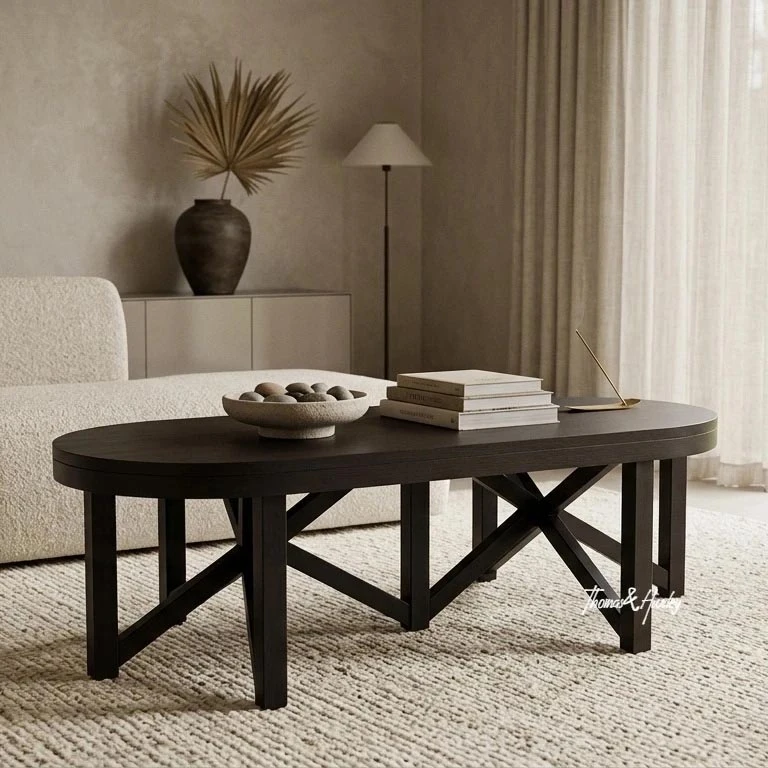
Black painted timber. The Parker Coffee Table has a hand-finished black paint-stroke patina with a subtly distressed look. It is dark and matte, with enough texture to feel handmade. This is a low-pattern, high-contrast surface.
White painted timber. The Hampstead Coffee Table is a pale, soft surface with storage below. This is a low-pattern, low-contrast surface that shows off objects with depth and texture.
If you are unsure how an object will sit, hold it against the table for a moment. The right piece will look like it belongs to the same family, either matching the warmth of the timber or deliberately contrasting with it. The wrong one will look pasted on.
3. Coffee Table Decor for Natural Teak
Teak log trunk tables are the ones that most reward restraint. The pattern in the timber is the decoration, so the objects on top should support it rather than compete.
Two or three pieces is usually plenty. A wide, shallow ceramic bowl in a pale glaze looks wonderful against the warm grain, and a slim vase with a few stems adds a soft vertical line. A single large book, laid flat, gives the arrangement a base. Smooth, matte and light pieces work best because they contrast with the rough, warm texture underneath.
Placement depends on the shape. On the round Maki, which measures 100 cm across and 45 cm high, a loose cluster slightly off the centre feels relaxed, and it leaves the outer edge free for cups. On the Monument, which is 120 cm wide and 80 cm deep, group your pieces towards one end and keep the other end clear. That gives you a styled zone and a working zone on the same table.
Because teak log tables have crevices and end-grain, a tray is your friend. It gives glasses and vases a flat footing, and it lets you lift everything away when you need the whole surface. Avoid adding lots of other heavy timber, such as chunky wooden bowls and carved objects, or the top will start to feel dense. Both the Maki and the Monument are made for indoor use, so keep them inside.
4. Styling a Black Timber Coffee Table
A dark table is a gift for light objects. The Parker, at 129 cm wide, 69 cm deep and 46 cm high, gives you a long oval canvas in black, and anything pale or luminous will stand out against it.
White and sand-coloured ceramics look crisp, pale stone feels calm, and glass catches the light without adding visual weight. Fresh greenery looks especially fresh against black, and a small bowl of lemons or a handful of pale stems turns the table into a still-life. A brass or brushed metal candleholder adds a warm glint that the matte finish does not produce on its own.
Avoid black-on-black. A dark vase on a dark table simply disappears, and the arrangement loses its shape. If you love dark objects, place them on a pale tray so they have something to sit against.
The Parker also has a sculptural cross-braced base that you can see from most angles. That is worth showing off, so keep the top a little more restrained than you would on a plain-legged table. A long, low arrangement runs along the oval naturally: a rectangular tray, a stack of books at one end, and a low vase at the other.
5. Styling a White Table With Storage
The Hampstead has a drawer and an open shelf, which changes the styling brief entirely. Because the clutter has somewhere to go, the top can stay light and considered. Use the drawer for remotes, coasters and the small items that would otherwise clutter the surface, and keep the top for a tray, a vase and one or two favourite objects.
The open shelf is a styling opportunity in its own right. A woven basket, a folded throw or a neat stack of magazines looks intentional and keeps everyday items close to hand. Treat the shelf as a lower layer and keep it tidy, because it is easy to see from the sofa.
White painted timber can look flat if everything on it is pale, so add depth. A timber tray, a darker book cover, an olive or sage vase, or a woven texture will give the surface some contrast and stop the arrangement from blending into the table.
If your coffee table is an ottoman, the approach is a little different. The Parker Coffee Table Ottoman pairs a linen-upholstered top with a timber frame, so it needs a firm tray to create a stable surface for drinks and books. The tray also lifts away when you want to use the ottoman as extra seating or a footrest.
6. Materials That Pair Well With Timber
Timber loves company, as long as the company is varied. Think in materials rather than individual objects, and try to bring in a few different ones.
- Ceramic. Matte or softly glazed pieces work with almost every finish. Choose shapes with some character, such as a rounded vase or a low, wide bowl.
- Stone. A marble, travertine or limestone tray, coaster or object adds cool, solid weight against warm timber.
- Glass. Clear or lightly tinted glass adds light without adding bulk, which makes it a good choice for dark tables.
- Linen and woven textures. Coasters, baskets and a table runner soften a hard surface and bring in tactile contrast.
- Metal. Brass or brushed metal introduces a small glint of warmth. Use it sparingly, as an accent rather than a theme.
- Living things. Flowers, branches, a small plant or a bowl of fruit add colour and movement that no ornament can.
A useful check is to ask whether your arrangement includes something hard, something soft and something living. If it does, it will almost always feel balanced.
7. Choosing a Colour Palette
Colour is where a coffee table connects to the rest of the room. The simplest approach is to pull two or three tones from things that are already there, such as a cushion, a rug or a piece of art, and repeat them on the table.
Natural teak sits happily in a palette of cream, stone, sage and soft blue, because those colours share its earthy warmth. Black timber suits crisp white, sand and a single strong accent. White painted timber is the most flexible, and it can carry almost any soft colour.
Try to resist introducing a completely new colour on the table. A bright orange bowl that appears nowhere else in the room tends to look accidental. If you want a bolder note, choose something that echoes another element, like a vase that matches a cushion or a book that picks up the colour of the artwork.
8. Protecting the Surface While You Style
A lot of coffee table decor ends up doing double duty as protection, which is good news, because the table is at its most useful when it is being used.
- Coasters. Keep a small stack on the table, and make them part of the look.
- Trays. A tray takes the wear instead of the timber and gives objects a stable base.
- Felt pads. A small felt pad under a ceramic bowl or a stone object prevents scratches.
- Candles. Always burn candles in a suitable holder, away from flowers, paper and the table's edge.
- Spills. Wipe them up straight away, and keep the table out of damp conditions.
Every finish has its own needs, so it is worth reading the Thomas & Hurley care guide before you settle on a routine for your piece.
9. Making Room for Real Life
The best styling in the world is wasted if the table cannot be used. Before you finish, think about what actually happens on this table in a normal week.
Drinks. Leave a clear stretch where a cup or glass can land. On a round table this is usually the outer edge, and on a long table it is one end.
Remotes and small items. A small lidded box, a shallow dish or a corner of the tray keeps them together and out of the way.
Children and pets. Keep fragile objects towards the middle of the table, put loose items on a tray, and consider moving very breakable pieces to a shelf or sideboard.
Entertaining. When guests arrive, lift the tray, put out a board of nibbles or a few glasses, and put the decor back afterwards. A table that can switch between styled and serving mode is a table that gets used.
10. Looking Beyond the Table
A coffee table never sits alone, so the last step is to step back and look at the whole seating area. A rug that extends beyond the table on all sides anchors the arrangement. A lamp nearby adds a soft glow in the evening. And repeating one element in a second spot, such as a bowl that matches a vase on the sideboard, helps the table feel connected to the room.
The table should also suit the seating around it. If you are still choosing, our range of armchairs and sofas pairs comfortably with each of the finishes above, and you are welcome to visit the Thomas & Hurley studio in Alexandria to see the tables in person. Please call ahead so we can confirm which pieces are on display.
|
Find the Right Coffee Table Browse our timber coffee tables in teak, black and white finishes, then call 02 8866 1455 to check what is on display at our Alexandria studio. |
Frequently Asked Questions About Coffee Table Decor
What should you put on a teak coffee table? |
|
Keep it simple, because teak already has plenty of pattern. Two or three pieces is enough, such as a shallow ceramic bowl, a slim vase with a few stems and a single large book. Smooth, pale objects contrast best with the warm grain, and a tray keeps them steady on the natural surface. |
How do you style a black coffee table? |
|
Use light objects against the dark surface. White or sand ceramics, pale stone, glass and fresh greenery all stand out, and a brass accent adds warmth. Avoid dark objects directly on the table, because they disappear. If you love them, place them on a pale tray. |
How do you style a coffee table with storage? |
|
Use the drawer for remotes, coasters and small items, and keep the top light with a tray, a vase and one or two favourite objects. Treat an open shelf as a lower display layer, with a basket, a folded throw or a neat stack of magazines. |
What colours go with a natural timber coffee table? |
|
Cream, stone, sage, soft blue and white all suit natural timber, because they share its earthy warmth. Pull two or three tones from the rest of the room, such as a cushion or a rug, and repeat them on the table so it feels connected. |
How do you protect a timber coffee table from marks and scratches? |
|
Use coasters for drinks, a tray under decorative objects and felt pads under ceramic or stone pieces. Burn candles in a proper holder, wipe spills straight away, and keep the table indoors and away from damp. Check the care guide for the specific finish on your table. |
How do you keep coffee table decor from looking cluttered? |
|
Limit the table to a few pieces, group them on a tray, and leave part of the surface clear for drinks and daily use. Choose objects in a tight palette of two or three colours, and vary the heights so the arrangement has shape without piling everything up. |