

Most shelf decor ideas start with the objects: the vases, the candles, the framed prints. This guide starts with the shelves. A bookcase has real dimensions, adjustable shelf heights and a fixed depth, and those decide what looks right far more than any single ornament does.
We use two of our Stonefield units as worked examples: the Stonefield Single Bookcase, with open shelves, and the Stonefield Single Display Wall Unit, with glass doors. Both are 108 cm wide, 240 cm high and 45 cm deep with adjustable shelves, so the numbers carry across to most tall bookcases. If you are still deciding between the two, our post on display cabinets or open bookcases compares them.
If you are working out how to style shelves for the first time, or refreshing a unit you already own, the aim is the same: a display that looks calm, is easy to live with and stays safely upright.
|
How do you style a shelf on a bookcase? Start with the unit, not the objects: set the shelf heights to suit what you own, put heavy and closed items low, keep the middle for the things you want to see and use the top for light, simple pieces. Leave a few centimetres above every object and keep the front edge tidy. The best shelf decor ideas follow the shelves. |
1. Read the Unit: Shelf Decor Ideas by Height Zone
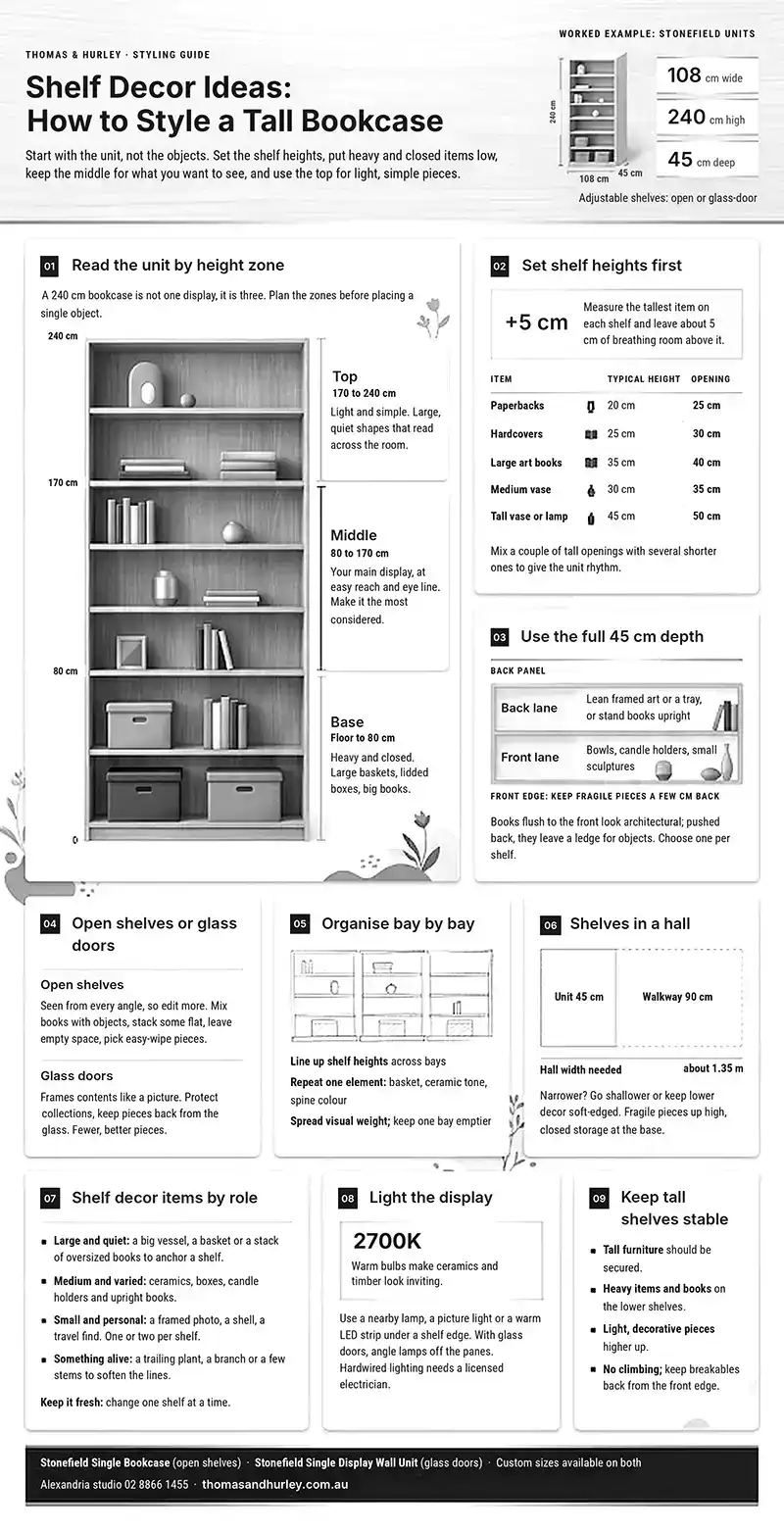
A 240 cm bookcase is not one display, it is three. What works at the base is different from what works at eye level, and different again near the ceiling. Splitting the unit into height zones before you place a single object saves a lot of rearranging, and it is the foundation of good shelf styling and of every shelf decor idea that follows.
| Zone | Height | What belongs there |
|---|---|---|
| Base | Floor to about 80 cm | Heavy and closed: large baskets, lidded boxes, big books, anything you reach for less often |
| Middle | About 80 to 170 cm | Your main display: the things you want to see and touch, at easy reach and eye line |
| Top | About 170 to 240 cm | Light and simple: large, quiet shapes that read from across the room, and things you rarely need |
The middle zone is where shelves with decor earn their keep, because it is the part of the unit people look at and use every day. Keep it the most considered. The base can be practical, and the top can be calm. Heights are a guide, so adjust them to your own reach and the height of your ceiling.
2. Set the Shelf Heights Before You Style
If you are wondering how to decorate shelves without the result looking crowded, begin with the shelves themselves. Both units in this guide have adjustable shelves, and it is worth using them. Setting the shelf heights first is the quickest way to make shelf decor look intentional, because every opening then suits what goes in it, instead of leaving big gaps above short items.
Work from your biggest items down. Measure the tallest thing that will sit on each shelf and add about 5 cm of breathing room above it. A shelf that is too tight makes objects look wedged in, and one that is too tall leaves dead space that is hard to fill. These approximate sizes give you a starting point.
| Item | Typical height | Opening to allow |
|---|---|---|
| Paperbacks | About 20 cm | About 25 cm |
| Hardcover books | About 25 cm | About 30 cm |
| Large art books | About 35 cm | About 40 cm |
| Medium vase | About 30 cm | About 35 cm |
| Tall vase or lamp | About 45 cm | About 50 cm |
You do not need every shelf to match. Mixing a couple of tall openings with several shorter ones gives the unit rhythm, and it gives you a place for the big pieces without forcing everything else to be oversized.
3. Use the Full 45 cm Depth
To make a shelf use its depth well, think of it as two lanes. At 45 cm deep, each shelf has room for more than one row, but a little under that is usable once the back panel and frame are allowed for. Use a back lane for flat or leaning pieces, and a front lane for objects.
In the back lane, lean framed art or a tray against the back, or stand books upright. In the front lane, bring forward the smaller objects, such as a bowl, a candle holder or a small sculpture, so they sit clear of what is behind them. Keep fragile items a few centimetres back from the front edge, especially in a home with children or pets.
Books themselves can go either way. Lined up flush with the front they look tidy and architectural, while pushed back a few centimetres they leave a ledge at the front for small objects. Choose one approach per shelf, so the front edge stays clean.
4. Open Shelves or Glass Doors: Styling Each Shelving Style
Shelving styles change how you style them. An open unit like the Stonefield Single Bookcase is seen from every angle and invites you to touch things, while a glass-fronted unit like the Stonefield Single Display Wall Unit frames its contents like a picture.
Open shelves. Everything on show gets looked at, so edit more. Mix books with objects, group books both vertically and in horizontal stacks, and allow some empty space on every shelf. Open shelves collect dust more readily, so favour pieces that are easy to wipe.
Glass doors. Things behind glass look more precious, which makes this the place for collections you would like to protect: ceramics, glassware, treasured objects. Keep pieces a few centimetres back from the glass so they do not rattle or reflect, and avoid stacking so tightly that the display looks crowded through the panes. Fewer, better pieces suit glass.
Many homes use both, and the same principles apply to each. If you would rather have a unit made to suit your wall, our post on whether a wall unit can be custom made explains what is possible.
5. How to Organise Display Shelves Bay by Bay
A single Stonefield unit is one bay, but many rooms use two or three side by side, or order a custom size. The question then is how to organise display shelves across several bays so the whole wall reads as one piece.
Start by lining up the shelf heights across bays so the shelves form continuous horizontal lines. That alone makes the wall look planned. Then vary the contents from bay to bay, with one repeating element tying them together: the same style of basket, the same ceramic tone or the same book spine colour.
Avoid putting the heaviest, darkest or tallest items all in one bay, because the unit will look lopsided. Spread visual weight across the wall and keep one bay a little emptier than the others. If you are planning something larger than the standard size, you can browse our wall units and display cabinets and ask about custom sizes.
6. Shelves in a Hall: Mind the Depth
Shelves in hall areas, or in any narrow entry, need more thought than shelves in a living room, because the unit shares space with people walking past. A unit that is 45 cm deep, plus about 90 cm of clear floor for walking, needs a hall roughly 1.35 m wide.
If the hall is narrower than that, choose a shallower unit or keep the decor soft-edged and low on the lower shelves, where hips and bags brush past. Put fragile and pointed pieces on the upper shelves, and save the base for closed storage. A mirror or artwork beside the unit also helps the space feel wider.
7. Shelf Decor Items by Role
These shelf decor ideas work best when you think in roles instead of a shopping list. Consider the role each piece plays. A balanced shelf usually has one large and quiet piece, a few medium pieces, one or two small personal ones and something alive.
- Large and quiet: a big vessel, a basket or a stack of oversized books. These anchor a shelf and work well at the base or the end of a row.
- Medium and varied: ceramics, boxes, candle holders and upright books. These do most of the work in the middle zone.
- Small and personal: a framed photo, a shell, a travel find. One or two per shelf are plenty.
- Something alive: a trailing plant, a branch or a few stems, which soften the straight lines of the unit.
Shelves with style rarely come from buying more. They come from choosing fewer pieces in a restrained palette and giving each one room. Start with the books and objects you already own, then add only what a shelf is clearly missing.
Once the unit is styled, keep it fresh by changing one shelf at a time. Swap the stems, rotate a few books or move a vessel to a different bay, and the whole unit looks new without a full restyle. Because the heights and zones stay the same, each small change slots in easily, and your shelf decor ideas never drift back to clutter.
8. Light the Display
Light is the cheapest way to make a bookcase look finished. A nearby lamp throws warm light across the shelves in the evening, a plug-in picture light or a warm LED strip under a shelf edge picks out individual pieces, and lighting inside a glass-fronted unit adds depth.
Choose warm bulbs, around 2700K, so ceramics and timber look inviting instead of clinical. With glass doors, angle lamps so they do not bounce off the panes, and wipe fingerprints from the glass now and then. Hardwired lighting inside a unit should be installed by a licensed electrician.
9. Keep Tall Shelves Stable
A 240 cm bookcase is tall furniture, and should be secured, but make sure you style with stability in mind too. Keep heavy objects and books on the lower shelves, so the weight sits low, and put light, decorative pieces higher up. Never let children climb on shelves or hang from them, and keep anything breakable away from the front edge.
|
Ready to Style a New Unit? Browse our wall units and display cabinets, or take a closer look at the Stonefield Single Display Wall Unit and the Stonefield Single Bookcase. Custom sizes are available on both. To see pieces in person, call the Alexandria studio on 02 8866 1455 and check what is on display. |
Frequently Asked Questions About Shelf Decor Ideas
How do you style a shelf on a bookcase? |
|
Set the shelf heights first so every opening suits what goes in it, then place heavy and closed items low, your main display in the middle and light pieces at the top. Leave about 5 cm above each object and keep the front edge tidy. |
How big should the gap above objects on a shelf be? |
|
Leave about 5 cm above the tallest object on each shelf. Any less looks wedged in, and much more leaves dead space. Adjustable shelves make it easy to fine-tune the openings. |
How should I style a glass-door display cabinet? |
|
Keep fewer, better pieces and place them a few centimetres back from the glass so they do not reflect or rattle. Treat the cabinet like a framed picture, and light it so the glass does not glare. |
How do I organise display shelves across several bays? |
|
Line up the shelf heights so the shelves form continuous lines, then vary the contents bay to bay with one repeating element, such as the same basket or ceramic tone. Spread heavy and dark pieces across the wall. |
What goes on the top shelf of a tall bookcase? |
|
Put light, simple pieces on the top shelf, such as a large quiet vase, a basket or something you rarely need. They read from across the room, and the weight stays low in the unit. |
How deep do shelves need to be for decor? |
|
A depth of around 30 cm is enough for books and one row of objects, and 45 cm gives you two lanes: leaning art or tall items at the back and small objects in front. Check the usable depth inside the unit, because the back panel takes a little. |
Do I need to fix a tall bookcase to the wall? |
|
Yes. Tall furniture can tip, particularly if children climb on it. Fix it to the wall with fixings that suit your wall type, and keep heavy items on the lower shelves. |