

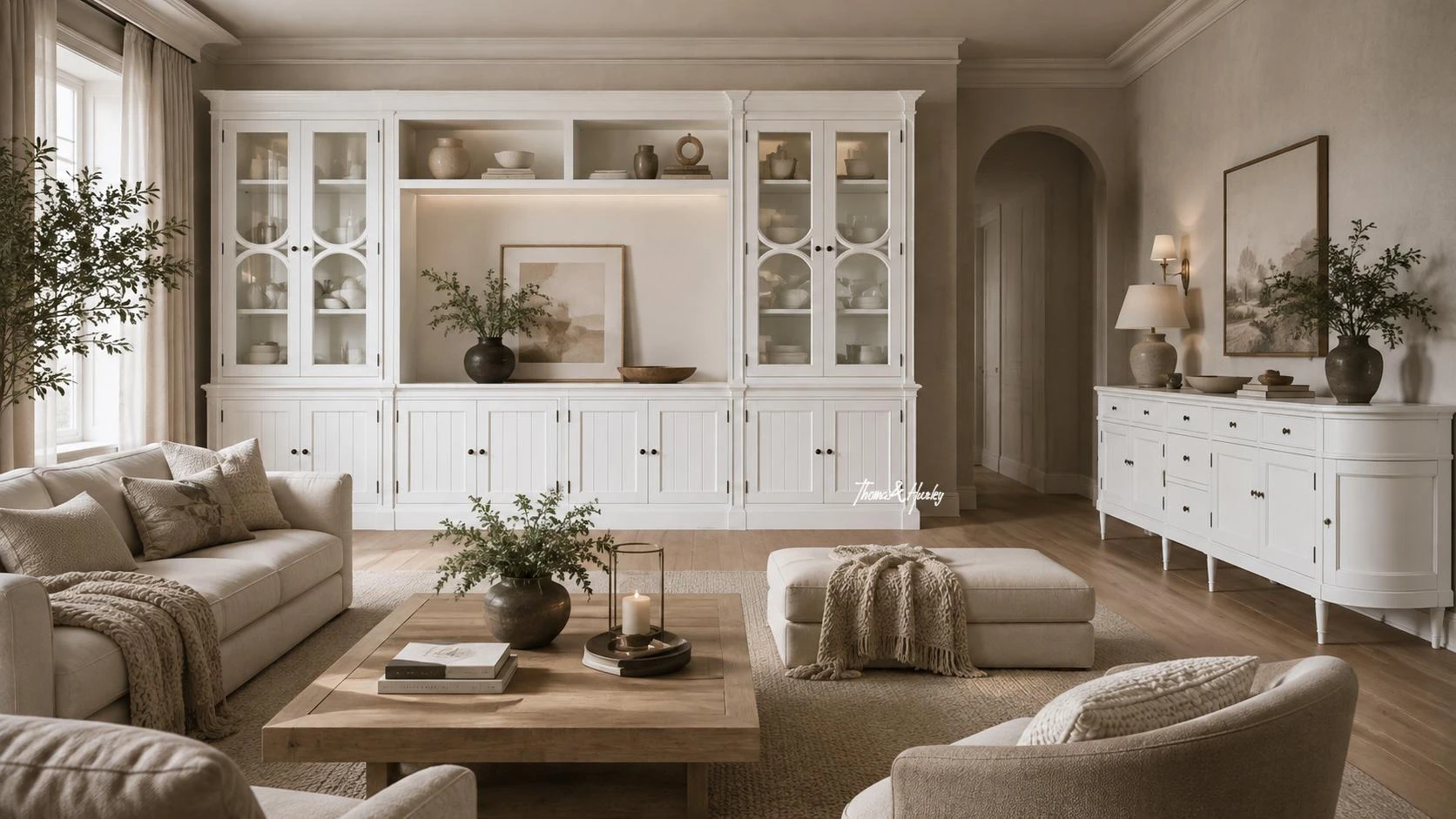
Some interior styles are separated more by geography than by philosophy.
French Provincial furniture brings to mind centuries-old country houses, graceful curves, carved timber and pieces bearing the marks of time. Hamptons style, by contrast, is usually associated with light-filled coastal homes, crisp cabinetry, relaxed upholstery and a fresh palette of whites, blues and natural timber.
Yet look a little closer and the two have much more in common than first appears.
Both value proportion over novelty. Both celebrate craftsmanship and natural materials. Both allow traditional furniture to coexist comfortably with everyday family life. And perhaps most importantly, neither needs to feel precious.
This shared language is why French and Hamptons style furniture can work so beautifully together in contemporary Australian homes.
Rather than recreating an 18th-century French interior or an American coastal house literally, the most sophisticated approach is to borrow selectively from each. A bombe commode might introduce French curvature into an otherwise restrained living room. A substantial oak dining table can bring European country-house character beneath contemporary lighting. A white display cabinet can provide the architectural clarity associated with Hamptons style interiors, while collected objects and aged finishes keep the room from feeling too new.
The result is neither purely French Provincial nor purely Hamptons.
It is something softer, more layered and particularly well suited to modern Australian living.
Why French Provincial Furniture Continues to Endure
The enduring appeal of French Provincial design lies partly in its imperfections.
Unlike the highly polished furniture associated with royal courts and formal Parisian interiors, provincial pieces developed in regional France where local craftsmen interpreted fashionable forms using available timbers and more restrained decoration.
The resulting furniture retained elegant proportions and graceful silhouettes, but with a quieter, more liveable character.
Curved fronts.
Turned legs.
Panelled doors.
Natural timber.
Painted finishes.
Simple carving.
Pieces were designed to belong to homes rather than exhibitions.
That distinction is still relevant today.
When seeking a luxurious French Provincial furniture range, what often appeals is not historical accuracy but atmosphere: furniture with enough detail to feel distinctive and enough restraint to sit naturally within a contemporary home.
Thomas & Hurley pieces such as the Featherington Commode, Hyacinth Bombe Commode/Sideboard, and Louis Curved Buffet demonstrate how those historical ideas can be interpreted for modern interiors.
The Bombe: Why Curves Still Feel Luxurious
Few silhouettes communicate French influence as immediately as the bombe.
The term refers to the outward swelling or curved form traditionally associated with French commodes. Historically, achieving these shapes required considerable cabinetmaking skill, which helped establish curved furniture as a marker of craftsmanship and refinement.
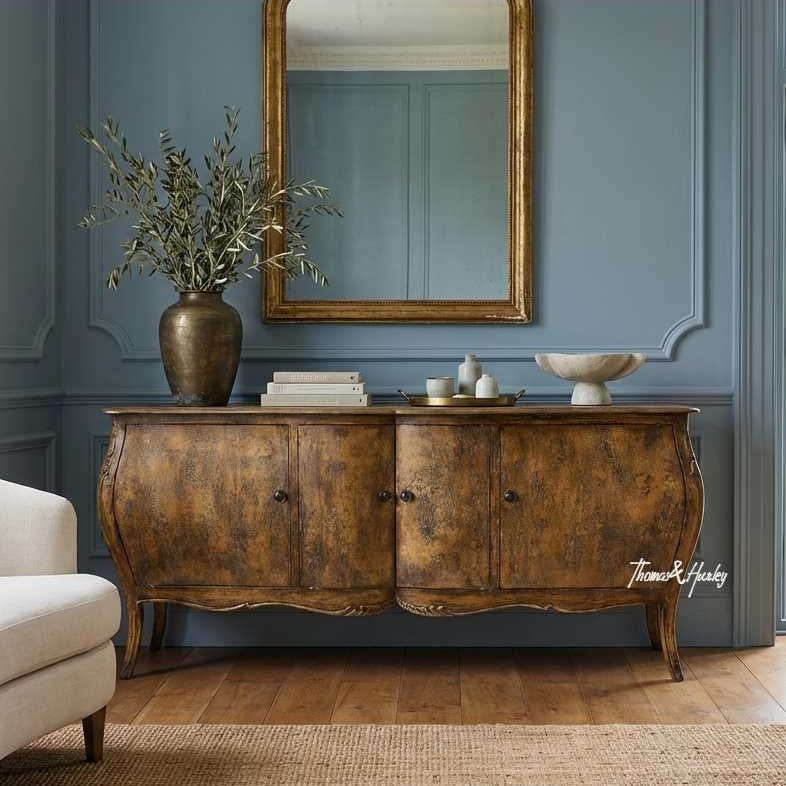
The Featherington Commode captures that sense of character beautifully.
Its generous curved front immediately softens the straight architectural lines surrounding it. Against a panelled wall and beneath a traditional gilt mirror, the piece feels comfortably connected to its French ancestry, yet the restrained styling prevents the room from becoming a historical recreation.
Instead, the commode functions almost like sculpture.
This is one of the most effective ways to incorporate French-inspired furniture into a contemporary Australian interior: allow one distinctive piece to provide the historical reference rather than asking every piece in the room to match it.
The room gains character without becoming themed.
The Hyacinth Bombe: When French Furniture Becomes the Accent
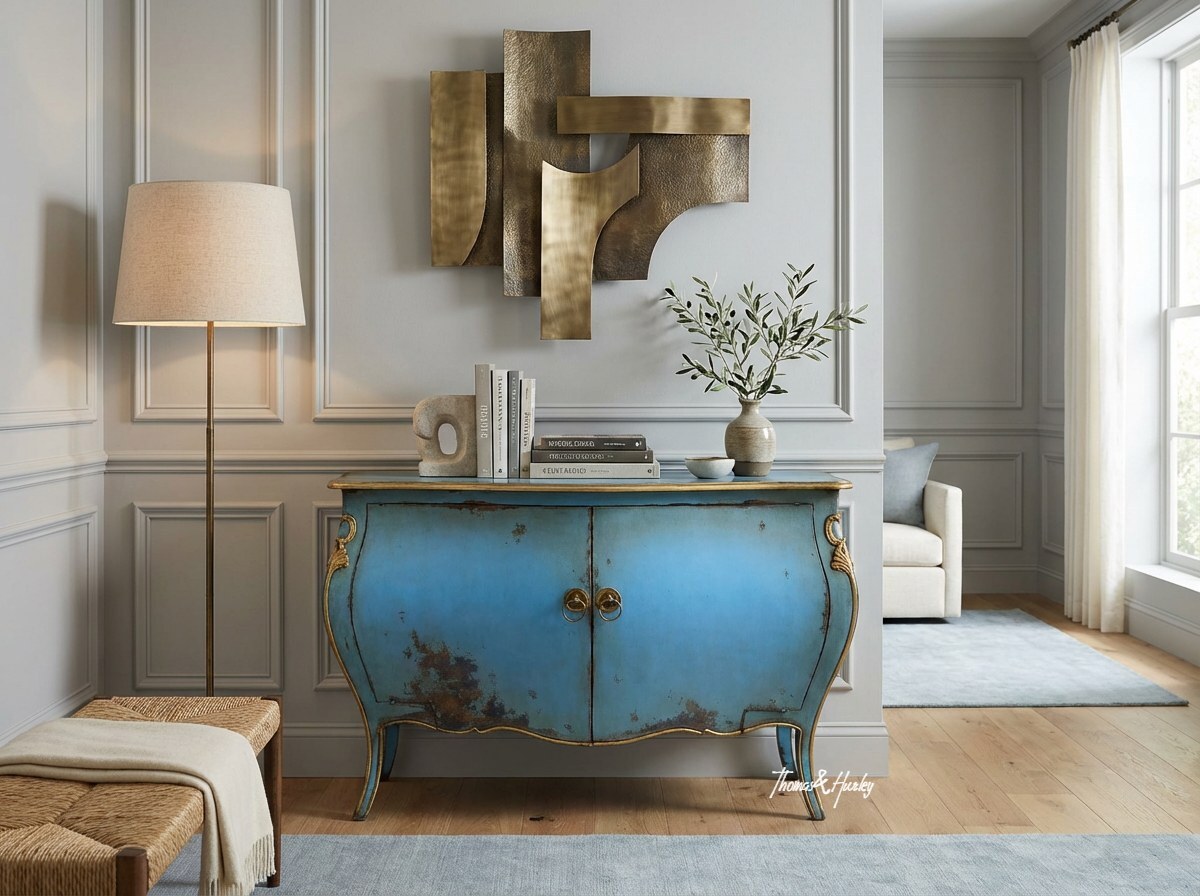
The Hyacinth Bombe Commode/Sideboard takes the same idea in a much more expressive direction.
Its blue finish immediately changes the mood.
Against pale walls and contemporary artwork, the traditional curved silhouette feels almost unexpected. That contrast is precisely what makes it successful.
Rather than treating French Provincial furniture as something that must sit within a neutral country palette, contemporary interiors can use colour to make traditional forms feel fresh.
The Hyacinth is particularly effective as:
- A hallway statement piece
- A dining-room sideboard
- A living-room accent
- A console beneath contemporary art
- A colourful counterpoint within a neutral room
This approach reflects a broader principle in decorating: a historical form can often tolerate considerably more experimentation than we imagine.
Sometimes the quickest way to make something traditional feel contemporary is simply to change the context around it.
Curved Furniture Without the Formality
The Louis Curved Buffet, shown in both white and black, illustrates another evolution of French-influenced furniture.
Here the curvature remains, but the overall language becomes cleaner.
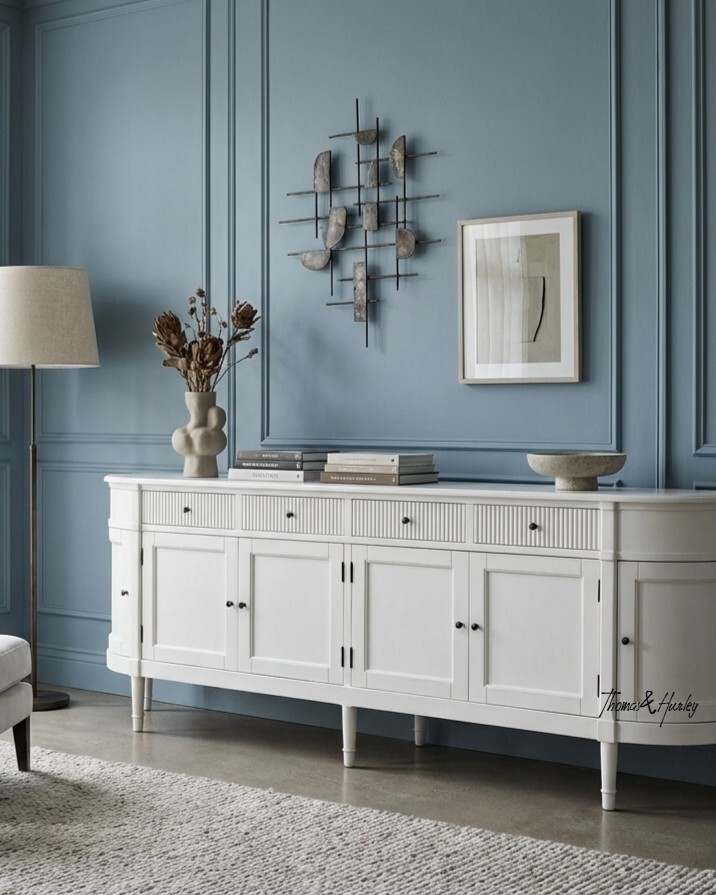
In white, the Louis feels relaxed and luminous. Its rounded ends soften a room while the pale finish allows the piece to sit comfortably within French provincial and coastal Hamptons Sydney interiors.
The black version tells a different story.
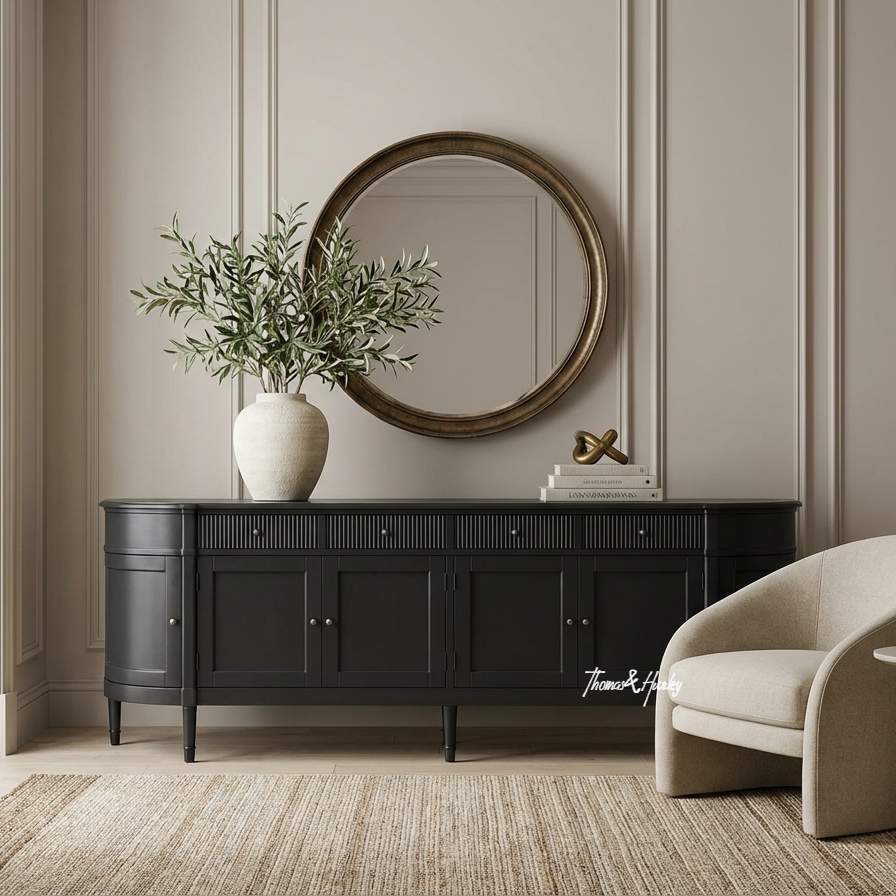
Against warm timber panelling, the darker finish creates a much stronger architectural line. Brass-toned details add warmth, while the curved ends prevent the substantial piece from feeling severe.
The same underlying furniture form therefore moves between:
- Luxury coastal
- Hamptons
- Contemporary classic
- Transitional
- Warm minimalist
- Modern European interiors
This versatility is one reason French-inspired furniture continues to resonate. The strongest designs are defined by proportion rather than surface decoration, allowing colour and context to completely alter their personality.
How Hamptons Style Softens French Formality
If French Provincial furniture introduces history, curvature and character, Hamptons style often introduces lightness.
White painted cabinetry, generous natural light, comfortable upholstery and a palette drawn from timber, linen, soft blue and warm neutral tones create an atmosphere that feels relaxed.
This makes Hamptons design a particularly effective companion to French-inspired furniture.
A bombe chest feels less formal beside a contemporary sofa.
A carved table feels lighter surrounded by simple upholstered chairs.
An architectural white display cabinet creates calm around collections of ceramics, books and antique objects.
The aim is not to divide the room into French and Hamptons components.
The best interiors bridge the gap between French charm and the fresh sophistication of Hamptons style interiors so naturally that the boundary becomes difficult to identify.
Stonefield: Architectural Hamptons Furniture for Modern Living
The Stonefield Display TV Media Entertainment Wall Unit demonstrates the more architectural side of this conversation.
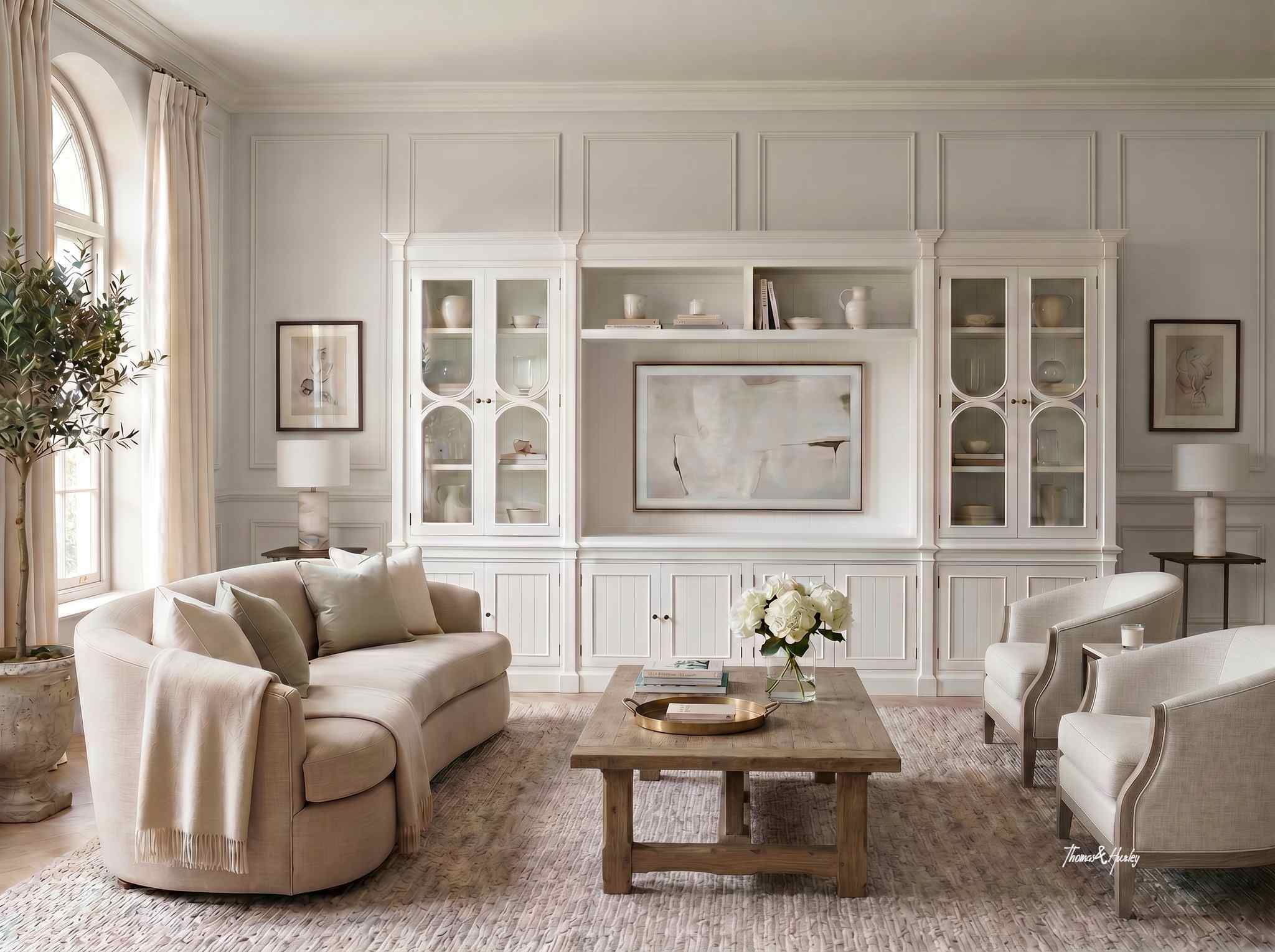
Its substantial white cabinetry brings symmetry and permanence to the living room, while glazed display sections provide room for books, ceramics and collected objects.
There is a distinct Hamptons influence in the combination of white cabinetry, panelled doors and carefully proportioned display sections.
But the idea itself has older precedents.
European homes have long used large-scale cabinetry, libraries and display furniture to structure rooms. The Stonefield essentially reinterprets that principle for contemporary life by integrating the television and modern storage requirements into something that still feels like furniture.
Technology becomes part of the architecture rather than its focal point.
This is particularly valuable in luxury Australian homes, where large open-plan rooms often benefit from a strong visual anchor.
When exploring Hamptons furniture in Sydney or architectural living-room storage, wall units can provide the sense of permanence traditionally associated with built-in joinery while retaining the character of crafted furniture.
The Somerset: Display Furniture as a Collection in Itself
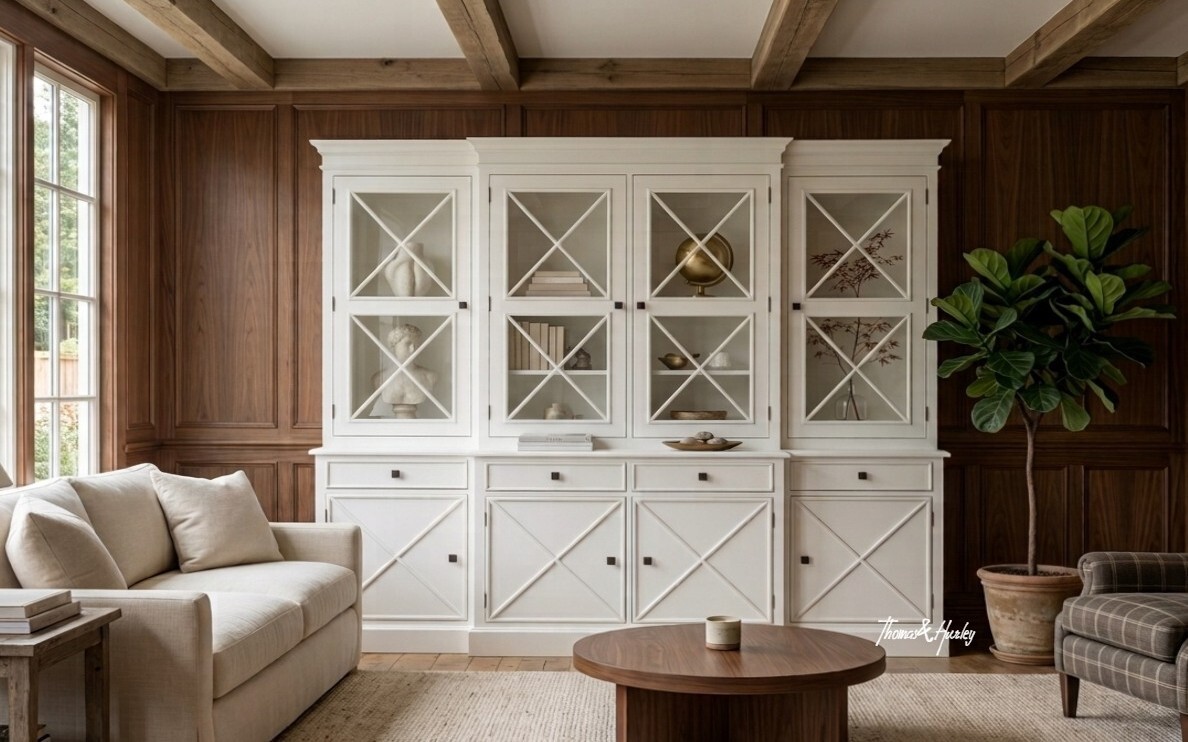
The Somerset 4 Door Display Wall Unit 300cm explores the same principle on a different scale.
Its glazed doors and decorative cross-detail invite objects to become part of the room.
This is where French and Hamptons influences converge particularly well.
French interiors have traditionally celebrated collections such as ceramics, books, glassware and decorative objects accumulated gradually over time.
Hamptons interiors often take a lighter approach to the same idea, using white cabinetry to create a calm framework around those objects.
The Somerset combines both sensibilities.
Styled sparingly, it can feel contemporary.
Filled with books and collected ceramics, it becomes warmer and more traditional.
Used in a dining room, it can function as elegant storage for tableware.
Furniture that can change character according to its contents has an important advantage: the interior can evolve without replacing the major piece itself.
The Churchill Table and the Beauty of Barley Twist
Few furniture details evoke European craftsmanship quite like the barley-twist leg.
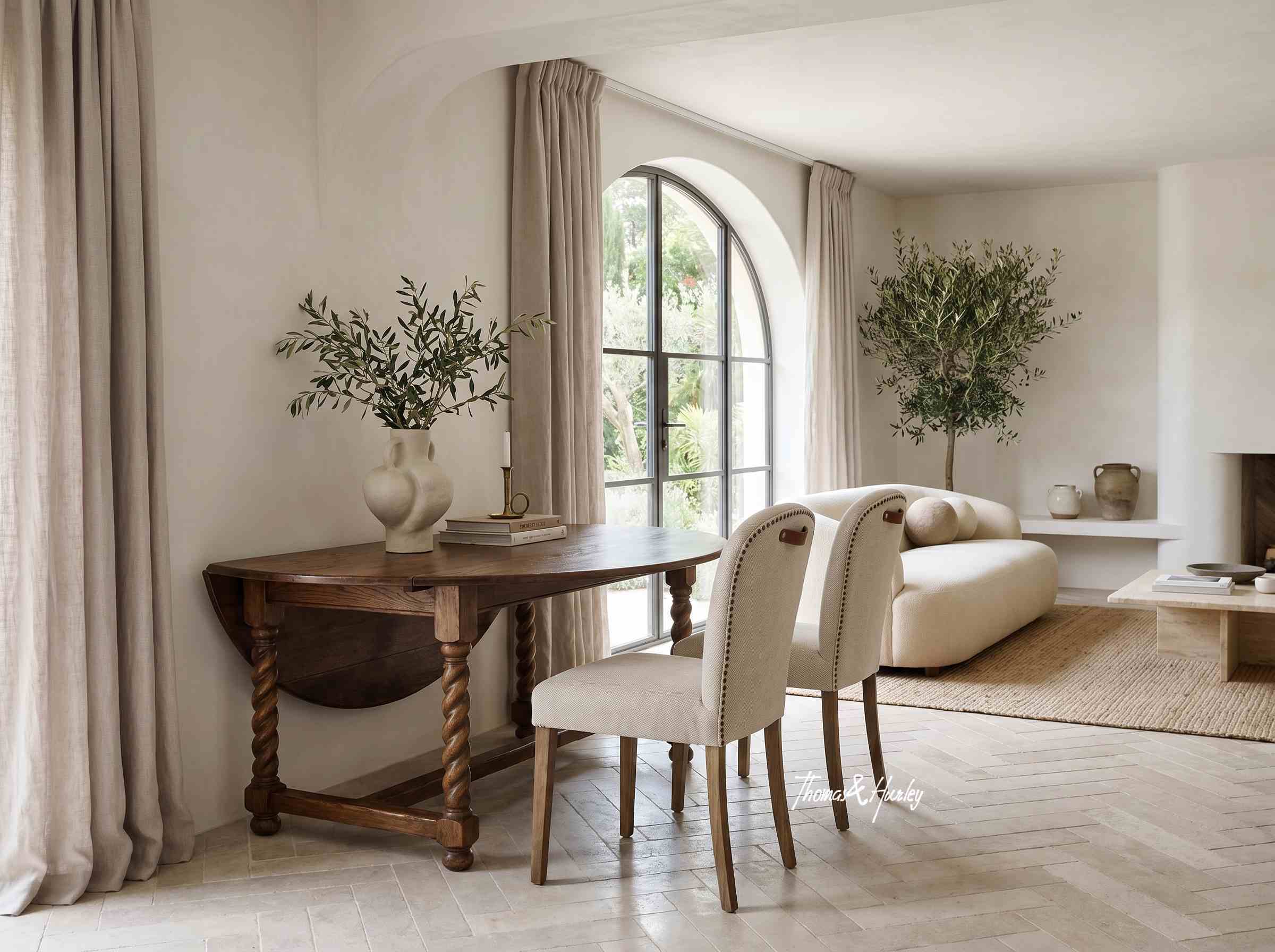
Its spiralling form became especially associated with furniture from the 17th century onward and has appeared repeatedly in English and Continental interiors ever since.
The Churchill Barley Twist Oval Drop Leaf Extending Table in Oak brings that detail into a remarkably versatile piece.
What makes it particularly interesting is the tension between decoration and practicality.
The turned legs introduce historical character.
The oak brings warmth.
The oval form softens the room.
And the drop-leaf extending functionality allows the table to respond to changing requirements.
Placed within a contemporary interior with pale walls, linen curtains and understated upholstered chairs, the Churchill no longer feels overtly traditional.
Instead, the barley twist becomes simply one beautiful detail.
That is often the secret to using French Provincial furniture in contemporary interiors: let the craftsmanship provide personality, then keep the surrounding room comparatively restrained.
The Harrington Hardwood Trestle Table: Country-House Character Without Heaviness
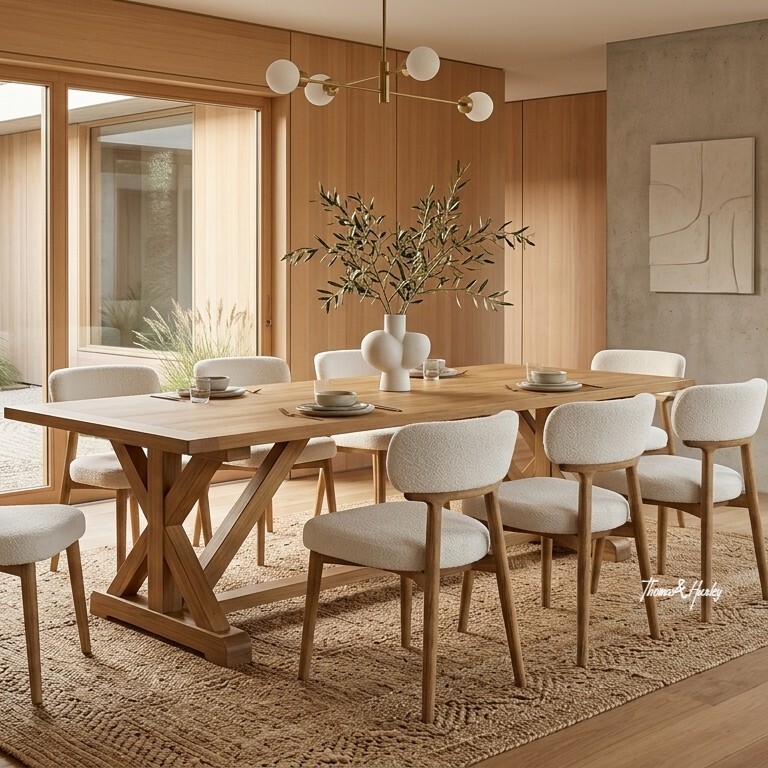
The Harrington Hardwood Trestle Base Dining Table moves closer to the shared territory between French country, Hamptons and contemporary Australian design.
Trestle tables have long associations with rural European interiors, where substantial timber furniture was valued for durability and usefulness.
Yet the basic architecture of the form is surprisingly modern.
A strong top.
A visible structural base.
Simple geometry.
The Harrington therefore works particularly well in rooms that mix traditional materials with cleaner contemporary elements.
Pair it with relaxed upholstered dining chairs and it moves toward luxury coastal.
Add woven seating and aged ceramics and it can feel Mediterranean.
Place it beneath a lantern pendant with painted cabinetry nearby and the mood becomes distinctly Hamptons.
This flexibility is precisely why well-designed hardwood dining tables remain such strong investment pieces.
They do not dictate the entire room.
They give it a foundation.
French Provincial vs Hamptons: Do You Really Have to Choose?
Not necessarily.
In fact, choosing one style too literally can sometimes make an interior feel less sophisticated.
A room filled entirely with traditionally French-inspired furniture may become overly formal.
A room in which every object is recognisably Hamptons can become predictable.
Combining the two introduces tension and personality.
Consider pairing:
A French curved buffet
with contemporary artwork and pale linen upholstery.
A Hamptons display cabinet
with antique books, aged ceramics and an old gilt mirror.
A traditional timber dining table
with cleaner upholstered chairs and contemporary lighting.
White architectural wall cabinetry
with timber, leather and collected objects.
The common language is what holds everything together: proportion, quality, restrained colour and natural materials.
The Importance of Patina
One quality French-inspired furniture brings particularly well to contemporary rooms is patina.
Highly polished interiors can sometimes feel newly assembled rather than naturally evolved.
A weathered timber finish, distressed surface or aged brass detail immediately introduces another timeline into the room.
This is why the Featherington Commode can sit so effectively beside clean contemporary upholstery.
It feels as though the room existed before the latest decorating scheme.
The aim isn't to make a new home appear artificially old.
It is simply to include pieces with enough visual depth that the interior doesn't feel like everything arrived on the same afternoon.
The most memorable homes often appear accumulated rather than completed.
How to Keep French and Hamptons Interiors Contemporary
The distinction between timeless and overly traditional often comes down to restraint.
Keep the Palette Controlled
Warm whites, stone, taupe, natural timber, muted blue, black and soft green provide a sophisticated foundation.
Mix Furniture Periods
Avoid buying an entire room in one matching style.
A French commode becomes more interesting beside contemporary upholstery.
Introduce Modern Art
Abstract artwork is remarkably effective above traditional furniture because each makes the other feel more intentional.
Use Natural Materials
Oak, linen, stone, wool, leather and ceramics bridge historical styles naturally.
Allow Negative Space
Traditional furniture does not need to be surrounded by decorative objects. Giving an ornate piece breathing room often makes it feel more modern.
Choose One or Two Strong Historical References
A barley-twist table or bombe commode can establish the mood without requiring the entire home to follow suit.
French and Hamptons Style Furniture for Australian Homes
There is a particular reason this combination works so well in Australia.
Our homes often favour natural light, generous entertaining spaces and a relaxed relationship between formal and casual living.
French Provincial furniture contributes craftsmanship, history and elegance.
Hamptons style contributes freshness, comfort and architectural clarity.
Australian living relaxes both.
The result can move effortlessly between a Sydney residence, coastal home, country property or contemporary suburban interior.
It also allows furniture to be selected for longevity rather than strict stylistic conformity.
That is an important distinction.
A beautifully made dining table or sideboard should be capable of surviving several iterations of the room around it.
Discover French Provincial Furniture in Our Sydney Showroom
If you're looking to explore the possibilities of French Provincial furniture and Hamptons style furniture in a Sydney showroom, experiencing these pieces in person can make a considerable difference.
Scale, timber texture, finish, curvature and craftsmanship are difficult to fully appreciate from photographs alone.
The Thomas & Hurley collection brings together furniture influenced by French Provincial, Hamptons, European country-house and contemporary-classic design, including statement dining tables, curved buffets, bombe commodes, display cabinetry and architectural wall units.
Customers can explore pieces through the Thomas & Hurley Sydney showroom, while Thomas & Hurley also works with customers throughout Australia.
For some collections, customisation also provides further possibilities, particularly with larger display and wall units where proportions and configurations may need to respond to an individual home.
A Home With More Than One Influence
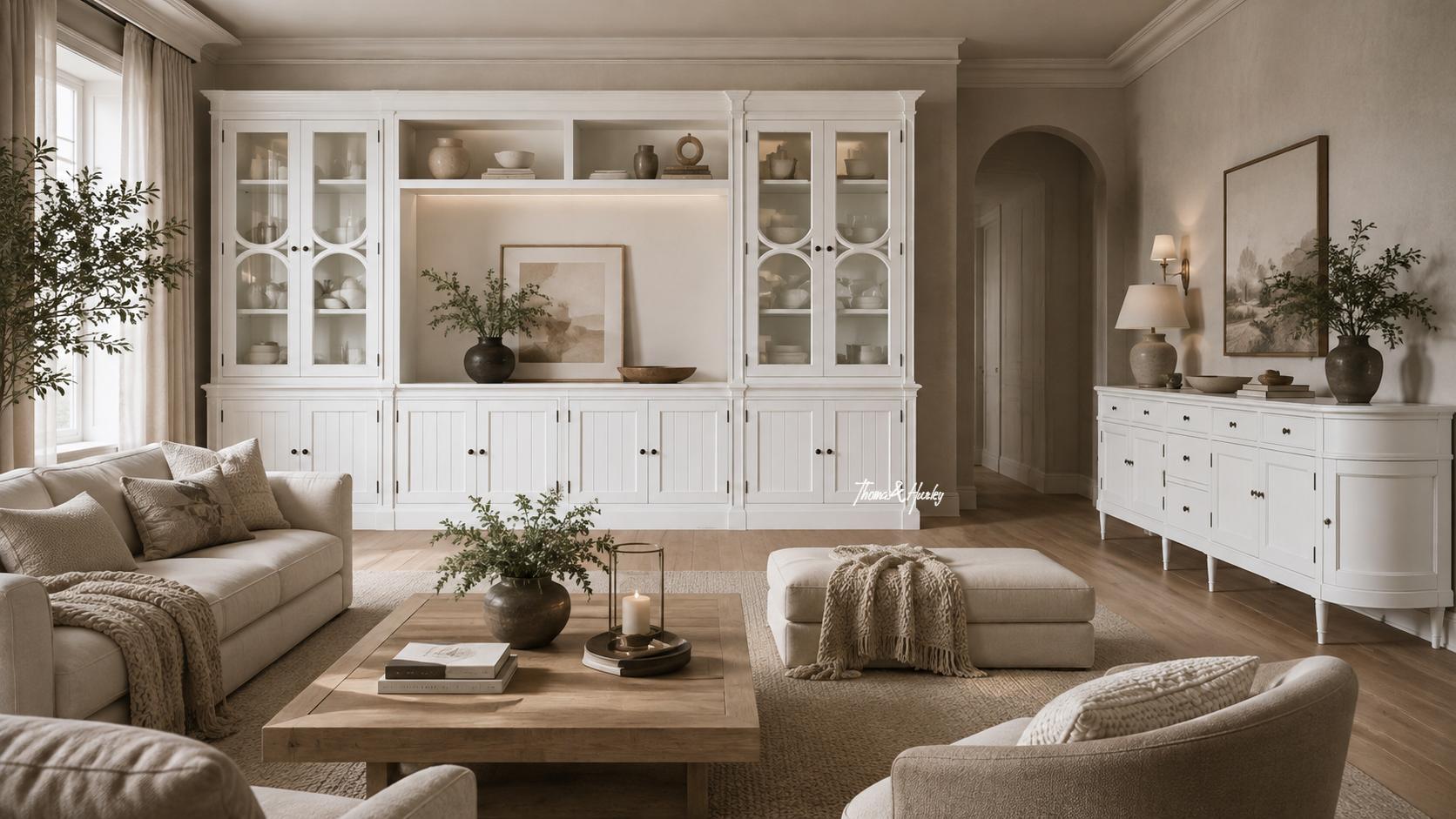
Perhaps the most compelling interiors are difficult to name.
They contain something French.
Something Hamptons.
Something contemporary.
Perhaps an antique.
Something unexpectedly sculptural.
A piece chosen simply because its owner loved it.
That is usually far more interesting than creating a room that follows the rules of a single style.
The Churchill Barley Twist Oval Drop Leaf Extending Table, Featherington Commode, Louis Curved Buffets, Hyacinth Bombe Commode, Harrington Hardwood Trestle Dining Table, Stonefield Display TV Media Entertainment Wall Unit and Somerset 4 Door Display Unit each demonstrate a different part of that conversation.
Some introduce history.
Some bring architecture.
Some provide colour.
Others bring the quiet confidence of beautiful proportion.
Together, they illustrate why French and Hamptons style furniture remains so relevant within contemporary Australian interiors.
The objective isn't to recreate France.
Nor is it to recreate the Hamptons.
It is to borrow what both traditions have always understood particularly well:
that a beautiful home should feel elegant without being untouchable, refined without losing warmth, and collected slowly enough to develop a character entirely of its own.