

A bedside table is easy to choose by eye and easy to get wrong. The mistake only shows up late at night, when you fumble for your phone in the dark and find the table a few centimetres too low, too tall or too deep for the bed.
This guide is about the numbers. It covers a two-minute measuring routine, how much higher or lower than the mattress a table can sit, and how width and depth fit the space you actually have. We use three of our own bedside tables as worked examples, so you can see real bedside table dimensions instead of vague ranges.
If your bedroom is on the small side, our post on how to make a small bedroom look bigger is a useful companion to the measuring steps below.
|
How do you choose the right bedside table height? Work out how high your mattress top sits above the floor, then look for a table whose top lines up with it or rises up to about 10 cm above. Check the width against the space beside the bed and the depth against your walkway, and test the footprint with tape before you buy. The right bedside table height is the one you can reach comfortably from lying down. |
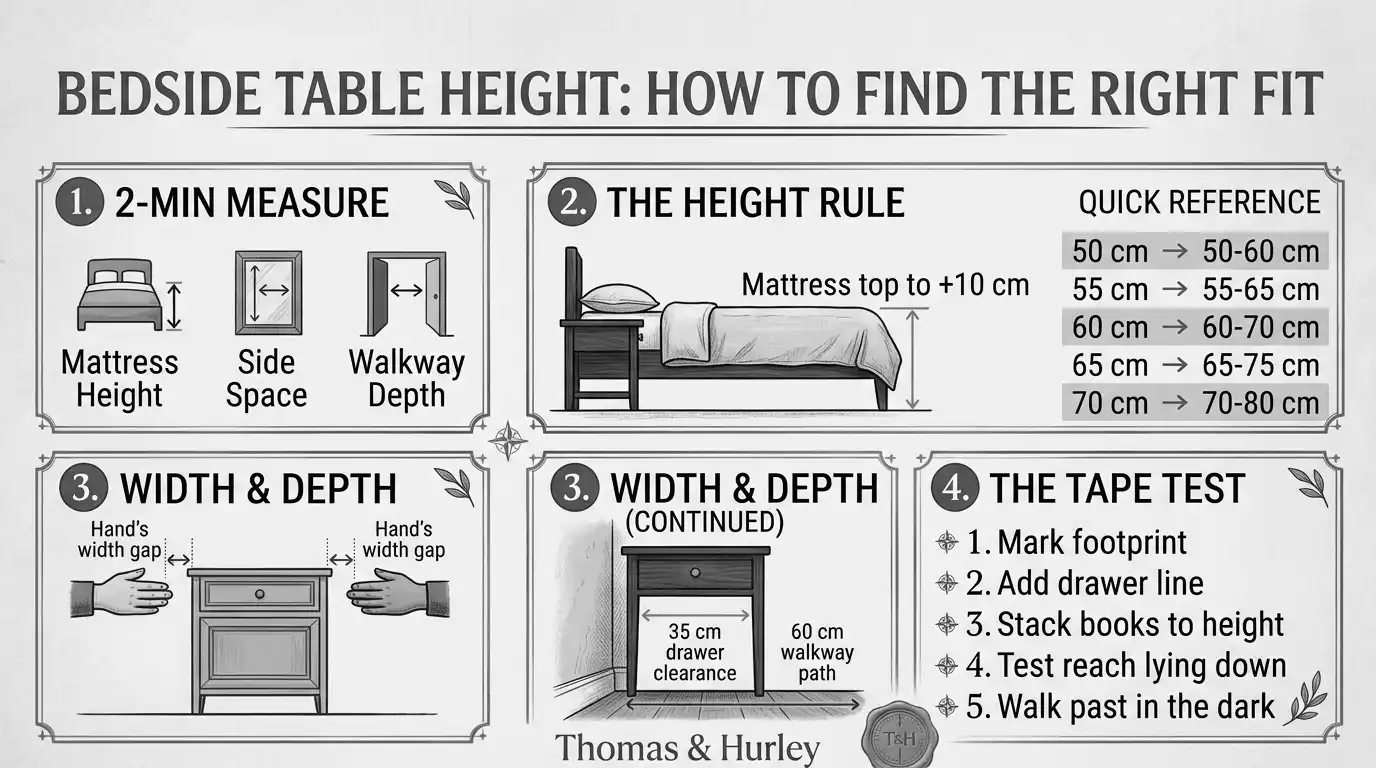
1. Measure Your Bed in Two Minutes
You need three numbers before you look at any table, and a tape measure gets all of them in about two minutes.
- Mattress height. With the bed made and the mattress and base in place, measure how high the mattress top sits above the floor, at the edge of the bed. This is the number your bedside table height is judged against, and it includes anything the bed sits on, such as a base, a frame or legs.
- Side space. Measure along the headboard wall from the edge of the bed to the nearest obstacle, such as a wardrobe, a door or a corner. That is the most width a table can take.
- Walkway. Work out how far a table can reach into the room before it gets in the way of the path to the door or bathroom. That is your depth limit.
Write the three numbers in your phone. They make browsing much quicker, because most product pages list width, height and depth, and you can compare each table against your own figures in seconds.
2. Which Bedside Table Height Suits Your Bed?
A bedside table does not need to match the mattress exactly. Treat the top of the mattress as your reference point and allow a small window above it.
Most people are comfortable with a table top that lines up with the mattress or rises as much as 10 cm above it. A lamp, a glass and a book are easy to reach from that height, and the table still looks in proportion beside the bed. Lower than the mattress is the awkward direction, because you end up reaching down and sideways and things get knocked off the edge. Much higher, say more than 15 cm above, and you are reaching up, which is tiring when you are half asleep.
That gives you a simple sum. Take your mattress height and look for a table between that number and that number plus 10 cm. A mattress top at 60 cm suits a table between 60 and 70 cm.
It works the other way round when you already have a table in mind. A 75 cm table suits a mattress top of about 65 to 75 cm, and a 72 cm table suits about 62 to 72 cm.
If you would rather read it off a chart, here is the same sum for a range of mattress heights.
| Your mattress top | Look for a table between |
|---|---|
| 50 cm | 50 to 60 cm |
| 55 cm | 55 to 65 cm |
| 60 cm | 60 to 70 cm |
| 65 cm | 65 to 75 cm |
| 70 cm | 70 to 80 cm |
Treat the chart as a starting point. Your own reach, how much you read in bed and how tall your lamp is all nudge the ideal bedside table height up or down a little, and the tape test later in this guide helps you settle on the final number.
3. Bedside Table Dimensions: Our Range at a Glance
Here are three of our bedside tables with their real dimensions, plus the mattress height each one suits using the 10 cm window above. You can see the rest of the range in our bedside tables collection.
| Table | Width | Height | Depth | Storage | Suits a mattress top of |
|---|---|---|---|---|---|
| Fremont Bedside Table | 62 cm | 72 cm | 41 cm | Two drawers and an open shelf | About 62 to 72 cm |
| Piastri 1 Drawer Bedside | 66 cm | 75 cm | 50 cm | One drawer, a pull-out panel and an open shelf | About 65 to 75 cm |
| Hampstead 1 Drawer Bedside | 60 cm | 75 cm | 44 cm | One drawer | About 65 to 75 cm |
All three sit between 72 and 75 cm high, which is taller than many bedside tables, so they suit a higher bed: a thick mattress on a base, or a bed on legs. If your mattress top is closer to 55 cm, a table at 72 or 75 cm will sit well above it, and a lower table will be the better fit. The measuring routine above will tell you which camp you are in.
4. Bedside Table Width: Fit It to the Space Beside the Bed
Bedside table width runs along the headboard wall, so the space beside the bed matters more than the bed size itself. Take your side space measurement and subtract the table width. What is left should split into a gap of about a hand's width on each side, so bedding does not catch on the table and the table is not jammed against a wardrobe or door.
Here is how that works with real tables. On 90 cm of wall space, the 66 cm Piastri leaves about 12 cm on each side. On a tighter 75 cm, the 60 cm Hampstead leaves about 7 cm on each side, which is still workable. If the sum leaves less than that, move down to a narrower table, and if you are comparing night table measurements across brands, check that the listed width includes any top overhang.
This is also why a queen bed in a narrow room may only take a 60 cm table, while a single bed in a large room can take something wider. Work from the space you have, and let the bed size follow.
5. Depth, Drawers and the Floor in Front
Depth is the third part of bedside table size, and it decides how far the table reaches into the room. Our three examples run from 41 cm for the Fremont to 50 cm for the Piastri, and that difference is bigger than it sounds when you are walking past in the dark. Add a comfortable 60 cm path in front of it and a 50 cm deep table needs about 1.1 m measured out from the wall.
Drawers add a second measurement, because a drawer needs floor space to open. Plan for it to open about as far as it is deep. The Hampstead's drawer is roughly 32 cm deep inside, so you want around 35 cm of clear floor in front, measured with the drawer fully out. Stand where you would get out of bed and picture opening the drawer there. If a bed frame, a bench or a wardrobe door is in the way, choose a shallower table or a different position.
Drawers also bring a safety point. Australian product safety guidance is clear that unsecured furniture can tip, particularly with young children around, so fix the table to the wall with fixings that suit your wall type and avoid opening more than one drawer at a time.
6. Drawers, Shelf or Both?
Once the size works, choose the storage by what you actually reach for at night. A night reader wants an open shelf for the current book and a notepad. Someone who charges a phone and hides the cables wants a drawer. Most people want a bit of both.
The Hampstead's drawer is about 6.5 cm high inside, which suits flat things such as a charger, glasses, a notepad and lip balm, but not bulky items. The Fremont offers two drawers and an open shelf, so it holds more, while the Piastri adds a pull-out panel to its drawer and shelf. Match the storage to your routine, not to the number of drawers on the spec sheet.
7. One Table or Two, and Matching Heights
Whatever bedside table height you settle on, it needs to work on both sides of the bed. If two people share the bed, a pair is the easy answer: one table either side at the same height, with matching lamps. It looks settled, and each sleeper gets a surface of their own.
If one side has less room, because of a door or a wardrobe, do not squeeze a matching table in. Put the larger table on the roomier side and use a smaller table or a wall light on the other. If you do mix tables, keep the heights within about 5 cm of each other so the two read as a deliberate pair instead of an accident.
8. Try Before You Buy: The Tape Test
Numbers on a screen only go so far, so test the table in the room before you buy it. It takes ten minutes and costs a roll of painter's tape.
- Mark the table's width and depth on the floor with tape, in the exact spot it would sit.
- Add a second line of tape in front of it for the drawer, as deep as the drawer is.
- Stack books or boxes to the table's height beside the bed.
- Lie down and reach for the top, then sit up and reach again.
- Walk past the footprint with the lights low, the way you would at night.
If the bedside table height still feels right after a night or two, you have your answer. If you keep clipping the tape or reaching up, change the size before you buy, not after.
|
Ready to Find Your Fit? Browse our full range of bedside tables, or take a closer look at the Fremont, the Piastri and the Hampstead. To see pieces in person, call the Alexandria studio on 02 8866 1455 and check what is on display. |
Frequently Asked Questions About Bedside Table Height
What is a comfortable bedside table height? |
|
Aim for a table top that lines up with the mattress or sits up to about 10 cm higher. Measure how far the mattress top sits above the floor with the bed made, and treat that figure as the bottom of your range. |
Is a bedside table too high if it is taller than my mattress? |
|
Not if it is within about 10 cm. A table up to that much above the mattress is still easy to reach, and a taller table gives a lamp more height. Above about 15 cm, you start reaching up, and a lower table will be more comfortable. |
What size is a typical bedside table? |
|
Sizes vary, but our own range gives a useful guide to bedside table dimensions: widths of 60 to 66 cm, heights of 72 to 75 cm and depths of 41 to 50 cm. Always check the numbers against your own mattress height, side space and walkway. |
How do I work out the right bedside table width? |
|
Bedside table width depends on the space beside your bed. Subtract the table width from that space and leave about a hand's width on each side. On 90 cm of wall space, a 66 cm table leaves about 12 cm either side. |
How much room do I need in front of a bedside table with drawers? |
|
Leave clear floor about as deep as the drawer, plus a comfortable path past it. A drawer about 32 cm deep needs around 35 cm of clearance in front so it can open fully. |
Can I use a side table as a bedside table? |
|
Yes, as long as the height suits your mattress and it has the storage you need. Several of our bedside tables are also sold as side tables, so they work next to a sofa or armchair as well. |
Do two bedside tables have to match in height? |
|
Keep both tables within about 5 cm of each other in height. A matching pair is simplest, but two different tables can work as a pair if their heights and overall scale are close. |