

Most guides to table setting begin with the cutlery. This one begins with the table, because the shape, width and base of your dining table decide how a setting actually fits. A layout that looks perfect in a diagram can be a squeeze on a narrow oval or a puzzle on a round table.
Below you will find how to set a table setting for everyday meals, then how to adapt it to round, oval and rectangular tables, how to plan the space down the middle, and how to keep the timber looking good while you do it. Each part is tied to a real tabletop, so the measurements are practical, not abstract.
A quick note on terms. The arrangement for one diner is called a place setting, and a table setting is every place setting plus whatever sits in the middle. We use both terms here, and the same basic rules apply to each.
|
What is the correct way to set a table? Build each place around the plate: forks to its left, a knife and spoon to its right with the cutting edge turned inwards, and a water glass at the tip of the knife. Then adapt that layout to your table by checking how much width you have, keeping the middle clear for serving and protecting the timber with mats or trivets. How to set a table setting depends as much on the table as on the cutlery. |
1. How to Set a Table Setting: The Everyday Layout
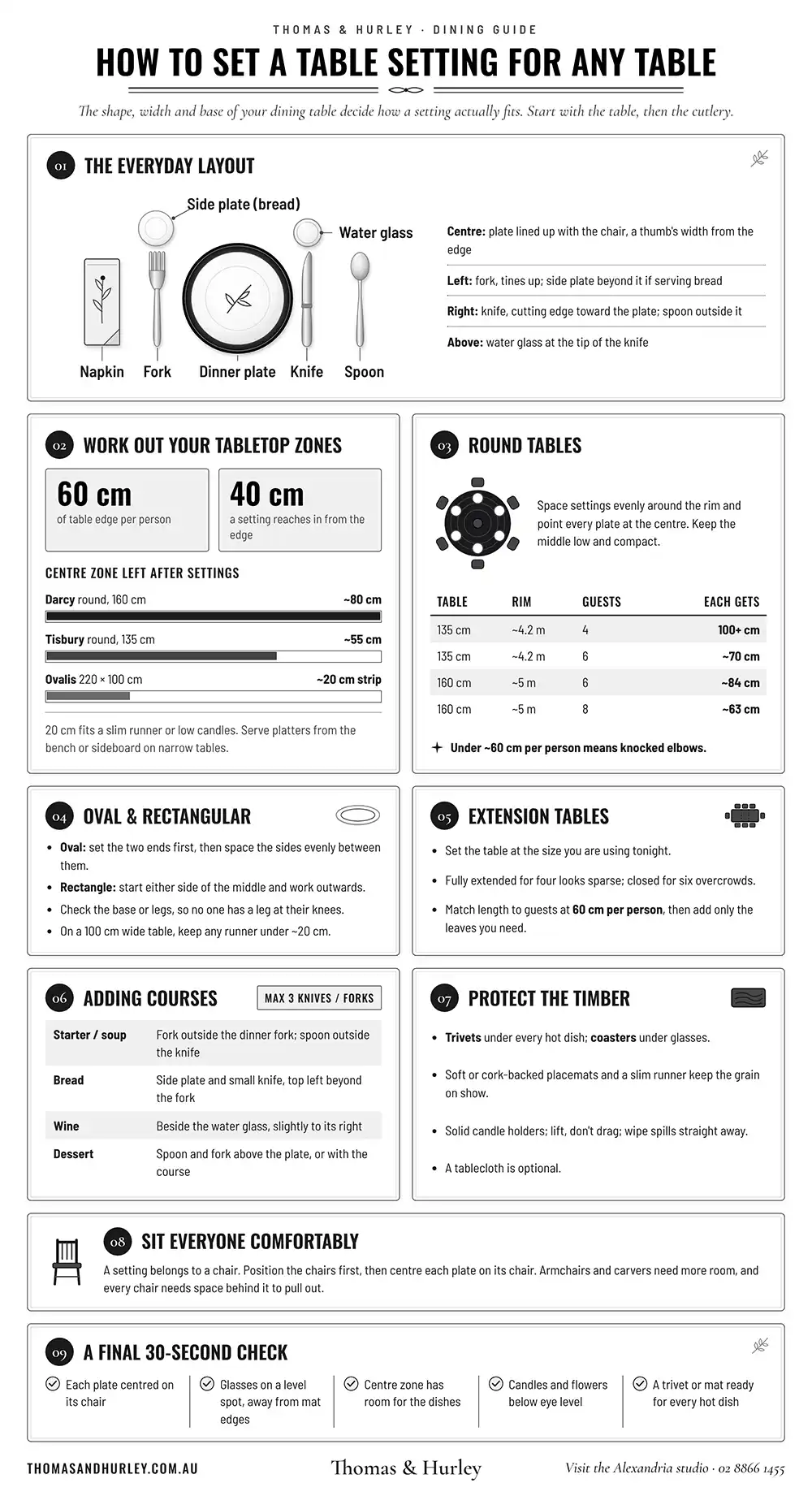
The everyday layout is the one to learn first, because every other layout is built on it. Think of it as four directions around the plate.
- Centre: the dinner plate, lined up with the chair and about a thumb's width in from the table edge.
- Left: the fork, tines up, with a side plate beyond it if bread is on the menu.
- Right: the knife next to the plate with its cutting edge toward it, and the spoon outside the knife.
- Above: a water glass at the tip of the knife. The napkin is folded beside the fork or resting on the plate.
That is a complete table setup for most weeknight dinners, and it is all you need if you have been wondering how to set a table for dinner at home. Dishes are added at serving time, and that is when the table itself starts to matter.
2. Work Out Your Tabletop Zones
Every table has two zones: the setting zone at each seat, and the centre zone that runs between the settings. As a comfortable guide, each person needs about 60 cm of table edge, and a setting reaches about 40 cm in from that edge. The width of your table then decides how much centre zone is left over.
It is simple arithmetic, and it explains why the same layout feels generous on one table and tight on another. Take three tables from our range:
| Table | Size | Centre zone left after settings |
|---|---|---|
| Tisbury Round Dining Table | 135 cm across | About 55 cm across |
| Darcy Oak Parquetry Round Dining Table | 160 cm across | About 80 cm across |
| Ovalis Dining Table, Natural Oak | 220 cm long, 100 cm wide | A strip about 20 cm wide at the middle |
A 20 cm strip is enough for a slim runner, a row of low candles or a few small vases. It is not enough for large serving platters, so on a narrow table it is better to serve from the kitchen bench or a sideboard and keep the table for plates and glasses. On a wider table, such as the 160 cm round, you can put a generous centrepiece and a couple of dishes in the middle without anyone reaching across a forest of glasses.
3. How to Set a Table Setting on a Round Table
A round table has no head and no corners, so the job is to space the settings evenly around the rim and point every plate at the centre. Centre each plate on its chair, and let the cutlery follow the plate, which means the knife and fork angle in very slightly rather than sitting square to the edge.
The rim gives you the real measure. A 135 cm table has a rim of about 4.2 m, which gives each of four guests over a metre and each of six guests about 70 cm. A 160 cm table has a rim of about 5 m, so six guests get about 84 cm each and eight get about 63 cm. Anything under roughly 60 cm per person starts to mean knocked elbows, so treat that as the ceiling for how many settings the table takes.
Because pedestal bases like those on the Tisbury and the Darcy have no corner legs, every seat is usable and chairs can go exactly where the settings are. Keep the middle low and compact: on the 135 cm table, a single small arrangement leaves room for dishes, while the 160 cm table can take something more generous.
4. How to Set a Table Setting on an Oval or Rectangular Table
On an oval, begin with the two end settings, then space the side settings evenly between them. The curve takes away corner space, so end settings often sit a little closer to the sides than they would on a rectangle. On a rectangular table, find the middle, place the two settings either side of it and work outwards in both directions with equal gaps, which keeps the whole row balanced.
Look at what is underneath too. The Ovalis has an angled trestle-style base, and any table with legs or a base at the ends can leave someone's knees in the way if a setting lands right on top of it. Pull the chairs into position first, sit in one if you can, and move the settings to suit the seats, not the other way round.
Running down the middle, remember the centre zone from earlier. On a 100 cm wide table, a runner wider than about 20 cm will slide under the plates, so choose a slim one or skip it and use a line of low candles instead.
5. Extension Tables: Set for Today's Size
If your table extends, set it at the size you are actually using that night. A table fully extended for four people looks sparse and leaves everyone far apart, while a table at its closed size can quietly overcrowd a group of six. When you work out how to set a table setting on an extending table, match the table length to the number of settings before you start, using the 60 cm per person guide, and put in the leaf or leaves that give you that. Our guide to how many dining chairs fit around a dining table covers seating numbers by table length, so there is no need to repeat it here.
If you are comparing extension tables, you can browse our full range of extendable dining tables.
6. Adding Courses Without Crowding
For a dinner party or a festive lunch, you build on the everyday setting one layer at a time, laying the first-used pieces on the outside and finishing nearest the plate. As a general convention, keep to no more than three knives or three forks at a setting, and bring any extras out with the course they belong to.
| Addition | What to add | Where it goes |
|---|---|---|
| Starter or soup | A starter fork, or a soup spoon | Fork outside the dinner fork, spoon outside the knife |
| Bread | A side plate and small knife | Top left, beyond the fork |
| Wine | A wine glass | Beside the water glass, slightly to its right |
| Dessert | A spoon and fork for dessert | Above the plate, or brought out with the dessert |
Every extra piece uses up space in the setting zone, so on a narrow table it pays to bring cutlery with the course instead of setting it all in advance. That keeps the table looking calm and leaves you room to move plates around.
7. Protect the Timber While You Set It
A timber dining table is the centre of the room, so it is worth protecting while you set it. The Tisbury has a brushed ash finish, the Darcy is burnished oak with a parquetry top and the Ovalis is natural oak, and each looks best with the grain showing.
Placemats and a slim runner give you protection without hiding the timber. Use trivets under every hot serving dish, coasters under glasses so condensation does not leave rings, and a holder with a solid base for candles so wax has somewhere to land. Soft or cork-backed mats are kinder to a finish than hard ones, and lifting plates and cutlery instead of dragging them saves scratches. Wipe spills straight away.
A tablecloth is optional. It suits a formal meal or an older table with marks you would rather cover, but bare timber with mats looks good for everyday dining. For advice on caring for your furniture, see the Thomas & Hurley care guide.
8. Sit Everyone Comfortably
A setting belongs to a chair, not just to a table. Good table placement starts with the chairs: position them first, then centre each plate on its chair, so the setting lines up with the person who will use it. Chairs with arms need a little more room than slim timber chairs, and a carver at the end of a table sits well when its arms can clear the table edge.
Leave enough space behind each chair for it to be pulled out and for someone to get in and out without squeezing past a wall or a sideboard. The size guide mentioned above has the clearances we recommend, so use it alongside this one when you plan the room.
9. A Final Check Before You Sit Down
Take thirty seconds at the end to walk around the table, and look for these five things.
- Each plate is centred on its chair, not just on the table.
- Glasses stand on a firm, level spot, away from table joins and the edges of mats.
- The centre zone has room for the dishes you plan to serve.
- Candles and flowers sit below eye level so people can see each other.
- There is a trivet or mat ready for every hot dish.
|
Ready to Set a New Table? Browse our dining and extension tables, or take a closer look at the Tisbury Round Dining Table and the Darcy Oak Parquetry Round Dining Table. To see pieces in person, call the Alexandria studio on 02 8866 1455 and check what is on display. |
Frequently Asked Questions About Table Settings
What is the simplest way to set a table for dinner? |
|
Keep each place to four parts: the plate in the middle, a fork on the left, a knife and spoon on the right, and a glass at the tip of the knife. A napkin can sit beside the fork or on the plate, and the serving dishes arrive when the food does. |
How much table does one place setting need? |
|
One place setting needs about 60 cm of table edge and reaches about 40 cm in from it. On a table that is 100 cm wide, two settings facing each other leave a strip of roughly 20 cm down the middle. |
How do you lay a round table? |
|
Space the settings evenly around the rim, centre each plate on its chair and keep the middle low for a small centrepiece. A 135 cm round table has a rim of about 4.2 m, so six guests get about 70 cm each. |
How should an oval table be laid? |
|
Place the two end settings first, then space the side settings evenly between them. Check where the base or legs sit so nobody ends up with a table leg at their knees. |
Should I use a tablecloth on a timber dining table? |
|
A tablecloth is optional. Placemats and trivets protect the timber while leaving the grain visible, and a cloth suits formal meals or an older table you would like to cover. |
Where do serving dishes go? |
|
For an informal meal, serving dishes go in the centre zone of the table, each on a trivet or mat. For a formal meal they usually stay on a sideboard or the kitchen bench and are brought out course by course. |
How should I lay an extension table for a small group? |
|
Set it at the size that suits the number of guests, using about 60 cm of table edge per person. Put in only the leaves you need, so the table does not look sparse and everyone stays within easy conversation. |