

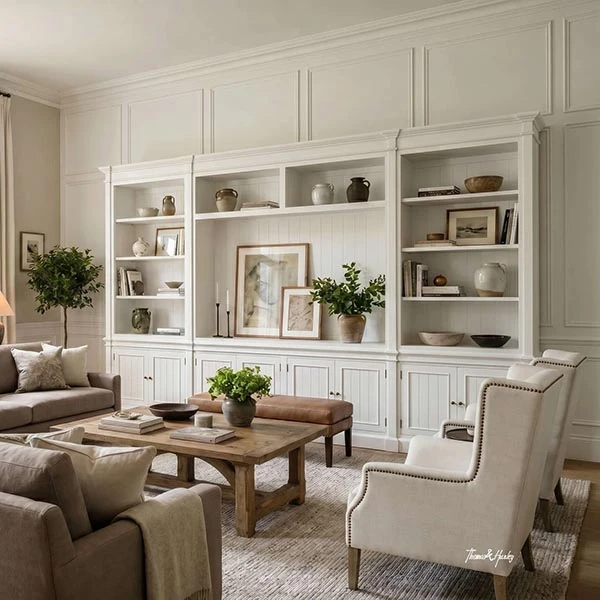
A television is a large, dark rectangle, and in most living rooms it sits right in the middle of the main wall. That makes TV unit decor a slightly awkward job. Style too little and the screen dominates the room. Style too much and the shelves look like they are fighting for attention with the picture.
The answer is to plan around the screen instead of pretending it is not there. This guide covers how to approach TV unit styling on a low media unit, a wall unit with a built-in TV space and an open bookcase, with examples from the Thomas & Hurley range. We look at balance and colour, how to hide the practical bits, and what to do when the TV is off.
|
How do you decorate a TV unit? Treat the TV as one part of the composition, not the whole thing. Style around the screen with something tall on one side, something low and wide on the other, and a few books or a tray to link them. Keep objects on a low unit well below the bottom edge of the screen, hide the cables and devices, and leave a little breathing space either side so the arrangement never competes with the picture. |
1. Why a TV Makes Styling Harder
Most surfaces in a living room are quite forgiving. A coffee table or a sideboard is a blank canvas, and you can arrange objects on it in almost any way. A TV unit has a giant screen in the middle of it, and that changes the rules in three ways.
First, the screen carries a lot of visual weight. It is dark, flat and large, so it pulls the eye more than anything else on the wall. Second, it takes up the central space, which means there is much less room for decor than there appears. Third, it is not really decoration at all, because you use it every day, so your styling needs to work around it instead of fighting it.
The goal, then, is not to hide the television or make it disappear. It is to build a composition that gives the screen a supporting cast, so the whole wall feels balanced whether the TV is on or off.
2. Know Your Unit Before You Style It
The way you decorate depends heavily on what kind of unit you have. Thomas & Hurley's TV entertainment units fall into three broad types, and each calls for a slightly different approach.
A low media unit. The Parker Media Unit Sideboard in black and the Parker in white are low units with glass front panels, shelving and elevated legs. The TV sits on top, or is wall-mounted above, and the styling happens on the surface and behind the glass.
A wall unit with a TV space. The Stonefield Display TV Media Entertainment Wall Unit is 387 cm wide and combines glass-fronted display cabinets with a space for the television. The screen becomes part of a larger piece of joinery, and the styling is mostly about the cabinets on either side.
An open bookcase unit. The Stonefield Bookcase TV Media Entertainment Wall Unit is also 387 cm wide, but with open shelving instead of glass. It is designed so the TV sits on the base, and the surrounding shelves work as a library wall.
If you are still deciding between glass-fronted cabinets and open shelving, our post on choosing a display cabinet or an open bookcase explains how each one changes the feel of a room.
3. Decorating a Low Media Unit
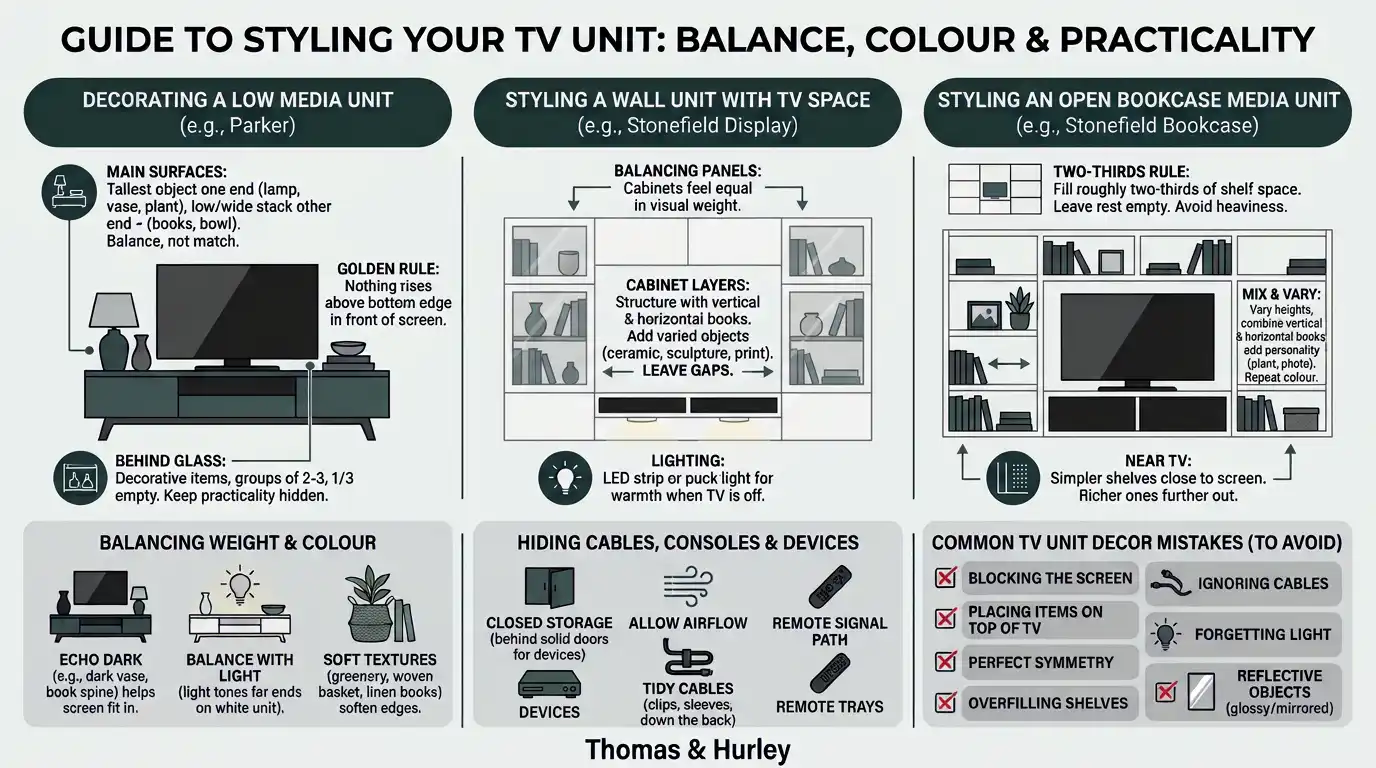
On a low unit like the Parker, the surface is where most of the TV unit decor happens, but it is also where most mistakes are made. The golden rule is that nothing on the surface should rise above the bottom edge of the screen, at least in the area directly in front of it. Anything taller creates a bump in the picture.
That leaves the ends of the unit as your main styling zones. Place your tallest object at one end, such as a table lamp, a ceramic vase or a small plant, and something lower and wider at the other end, such as a stack of books with a bowl on top. The two sides will not match, but they will balance, which is what you want.
Between them, keep the space under the screen quite clear. A single low tray, a couple of coasters or a shallow bowl is fine, but resist the urge to fill the gap. A little empty timber makes the styling feel deliberate.
Behind the glass fronts, the rules change. This is where you can be more decorative, with a few books, a ceramic piece or a small framed photo. Keep the arrangement loose, group objects in twos or threes, and leave at least a third of each shelf empty so it does not look stuffed. Because the Parker has glass panels, avoid storing anything you would not want seen there, and keep the consoles and cables to a solid-fronted cupboard or a separate shelf.
4. Styling a Wall Unit With a TV Space
A large wall unit such as the Stonefield Display TV Media Entertainment Wall Unit turns the whole wall into a piece of architecture. The TV is set into the middle, and the display cabinets on either side become the main event.
The trick is to think of the cabinets as two panels that balance each other around the screen. They do not need to be identical, but they should feel of equal weight. If one side has a large vase, the other should have something of similar presence.
Inside each glass-fronted cabinet, work in layers. Start with books, stacked both horizontally and vertically, to give the shelf some structure. Add a few objects of different heights, such as a ceramic vessel, a small sculpture or a framed print leaning at the back. Then leave gaps. A cabinet where every shelf is full looks like a shop window, while one with a few well-chosen pieces looks collected.
Lighting also helps. A small LED strip or a puck light inside a cabinet turns the display into a feature when the TV is off, and it adds a soft glow in the evening without competing with the screen.
At 387 cm wide, this unit is a substantial piece. Measure your wall carefully, allow for the depth of the unit, and check that the TV you plan to use fits the space.
5. Styling an Open Bookcase Media Unit
An open bookcase unit like the Stonefield Bookcase version offers more freedom, and a bit more risk, because everything on the shelves is on show all the time.
The easiest approach is the two-thirds rule. Fill roughly two thirds of the shelf space with books and objects, and leave the rest empty. Empty shelves are not a failure of styling. They are what stops the wall from feeling heavy.
Mix vertical and horizontal stacks of books, and vary the heights so there is a rhythm across the unit. Add a few objects that reflect you, such as a ceramic piece, a small plant, a framed photograph or a favourite travel find. Repeat one colour or material every few shelves, so the eye travels across the whole wall.
Keep the shelves closest to the TV a little simpler. Busy shelving right next to the screen can make the picture feel cluttered, while quieter shelves close to the TV and richer ones further out create a natural sense of depth.
6. Balancing Weight and Colour Around the Screen
The screen is dark, so the TV unit decor around it needs to be chosen with that in mind.
Echo the dark. A few dark objects near the TV, such as a black ceramic vase, a dark book spine or a charcoal frame, help the screen feel like part of the composition instead of an intruder. Repeat the same dark tone a couple of times across the unit.
Balance it with light. On a white unit like the Parker in white or the Stonefield in white, add a few light-toned pieces at the far ends to stop the wall feeling top-heavy on the dark side.
Bring in soft, natural texture. Greenery, a woven basket or a linen-covered book will soften the hard edges of the screen and the unit. A trailing plant on the top of a low unit, kept clear of the screen, works especially well.
Keep the palette tight. Two or three colours, pulled from the rest of the room, will look more considered than a scattering of unrelated shades. If your sofa is neutral, one soft accent colour repeated across the unit is usually plenty.
7. Hiding Cables, Consoles and Devices
The quickest way to spoil good TV unit decor is to leave the cables and devices in view. A few habits make a big difference.
- Keep devices in closed storage. Streaming boxes, consoles and soundbars are best kept behind a solid door, not a glass one. Glass fronts show everything.
- Allow airflow. Electronics need ventilation, so do not pack them tightly into a closed space. Leave gaps around each device.
- Mind the remote signal. Some remotes work best with a clear line to the device. If a door blocks the signal, leave it slightly open or place the device where it can be reached.
- Tidy the cables. Bundle cables with clips or sleeves, run them down the back of the unit and keep power boards out of sight.
- Give remotes a home. A small tray or lidded box on the unit keeps them together and stops them wandering.
Check the openings at the back of your unit before you buy or arrange anything. A unit with a cable hole or a gap at the back makes the whole job much easier.
8. Styling for When the TV Is On and Off
Your TV unit decor will spend some of the day with the screen on and some of it off, so it needs to look good both ways.
When it is off. The screen becomes a dark panel in the middle of the wall. Objects placed to either side, and the texture of the unit itself, do most of the work. Cabinet lighting and a lamp at one end will make the wall feel warm and finished.
When it is on. The screen is the star, and everything else recedes. Avoid shiny objects close to the screen, because they can reflect the picture and become a distraction. A lamp at one end of the unit should be angled or positioned so its bulb does not reflect on the display.
In the evening. A soft light behind or beside the TV reduces the contrast between the bright screen and the dark wall, which is easier on the eyes. A small lamp on the unit or a light strip behind it does the same job.
9. Keeping It Tidy With Family
A TV unit is one of the most-used pieces of furniture in a family home, so good TV unit decor needs to be practical as well as pretty.
Use baskets and closed storage for toys and games. A basket at the base of a unit or a cupboard with a solid door keeps clutter away from the decorative shelves.
Do a quick reset. A two-minute tidy at the end of the day, returning remotes, straightening books and clearing cups, keeps the styling looking intentional.
If you would like to see how the different units look in a room, you are welcome to visit the Thomas & Hurley studio in Alexandria. Please call ahead so we can confirm which pieces are on display.
10. Common TV Unit Decor Mistakes
Objects that block the screen. Anything that rises in front of the picture will annoy you every time you watch. Keep the space directly under the screen low.
Placing items on top of the TV. Objects on a television can block ventilation. Keep the top of the set clear.
Perfect symmetry. Matching objects on both sides of the screen can look stiff. Aim for balance, not mirror images.
Overfilling the shelves. A packed shelf reads as clutter, not as a collection. Leave gaps.
Ignoring cables. A tangle of leads is the first thing a visitor notices. Tidy them before you style anything.
Forgetting the light. A unit with no lighting looks flat in the evening. A lamp or cabinet light adds warmth.
Choosing objects that reflect the screen. Glossy, mirrored items next to the TV can bounce the picture around the room. Matte finishes work better.
|
Find the Right TV Unit Browse our media units and wall units, then call 02 8866 1455 to check what is on display at our Alexandria studio. |
Frequently Asked Questions About TV Unit Decor
How do you decorate a TV unit? |
|
Plan around the screen. Put something tall at one end, something low and wide at the other, and a few books or a tray to link them. Keep everything below the bottom edge of the screen in front of the picture, and leave part of the surface clear so the arrangement feels balanced. |
What should you put on either side of a TV? |
|
A lamp, a vase with stems or a small plant works well on one side, with a stack of books and a bowl on the other. The two sides should feel equal in weight without matching exactly. Keep them low enough that they do not block the view from the sofa. |
How do you style a wall unit with a TV in it? |
|
Treat the cabinets on either side as two panels that balance the screen. Layer books, a few objects of different heights and a framed print on each shelf, and leave a third of the space empty. A small light inside the cabinets adds warmth when the TV is off. |
How do you hide TV cables and devices? |
|
Keep devices in closed storage behind a solid door, bundle the cables with clips or sleeves and run them down the back of the unit. Leave gaps around electronics for airflow, and keep power boards out of sight. |
Can you put decor on top of a TV? |
|
It is best not to. Objects on top of a television can block ventilation. Style the surface of the unit around the screen instead, and keep the top of the set clear. |
How do you stop a TV from dominating the room? |
|
Give the screen a supporting cast. Echo its dark tone with a few dark objects, soften the wall with greenery and texture, and add a lamp or cabinet lighting so the wall looks warm when the TV is off. A wall unit or bookcase around the screen also makes it feel part of the joinery. |