

The most useful rooms are rarely defined by a single purpose.
A living room becomes somewhere to answer emails in the morning. A quiet corner becomes a place to write, read or plan. A dining area occasionally needs to accommodate more guests. A piece of furniture that spends most of the week looking beautifully composed may need to become genuinely functional within moments.
This is not necessarily a new way of living.
Long before the dedicated home office became commonplace, furniture was designed to adapt. Writing tables appeared in drawing rooms and libraries. Campaign furniture folded, opened and travelled. Drop-leaf tables expanded when required and became remarkably compact when they were not.
Today, that same flexibility feels particularly relevant.
The Stonefield Writing Desk 160cm, Reagan Oak Campaign Convertible Writing Desk and Churchill Barley Twist Oval Drop Leaf Extending Table by Thomas & Hurley demonstrate three very different approaches to adaptable furniture. One offers the elegance and permanence of a traditional writing desk. Another conceals a workspace within what appears to be a beautifully proportioned cabinet. The third transforms from a compact occasional table into a larger surface when required.
Together, they suggest a more relaxed way of thinking about the home office.
You may not need an office at all.
You may simply need the right piece of furniture in the right part of the room.
The Return of the Writing Desk
There is something inherently appealing about a writing desk.
Unlike the conventional office desk, which tends to announce its function immediately, a writing desk can feel equally at home in a living room, bedroom, library or entrance hall. Its proportions are often lighter, its design more decorative, and its relationship with the surrounding furniture more considered.
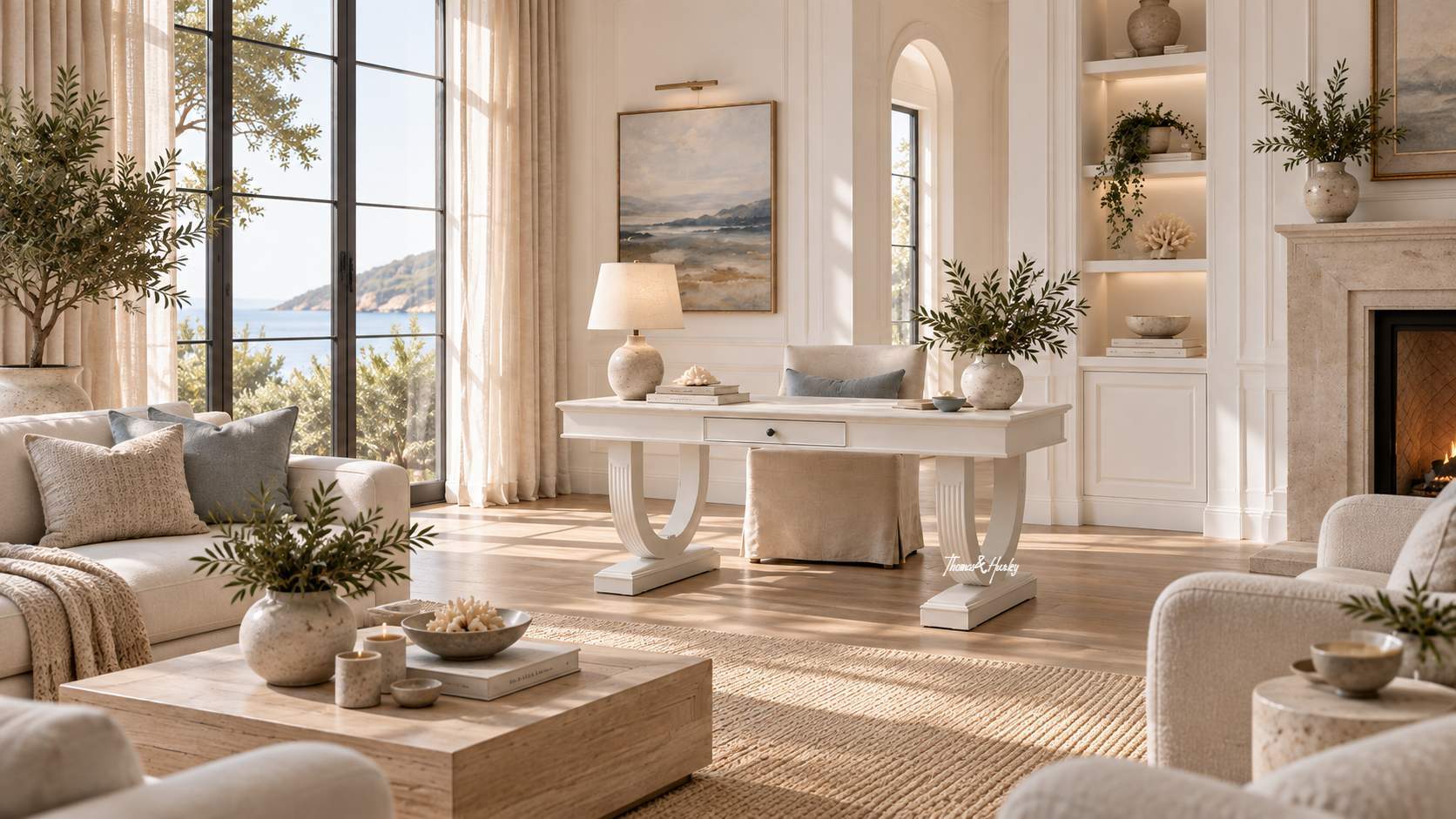
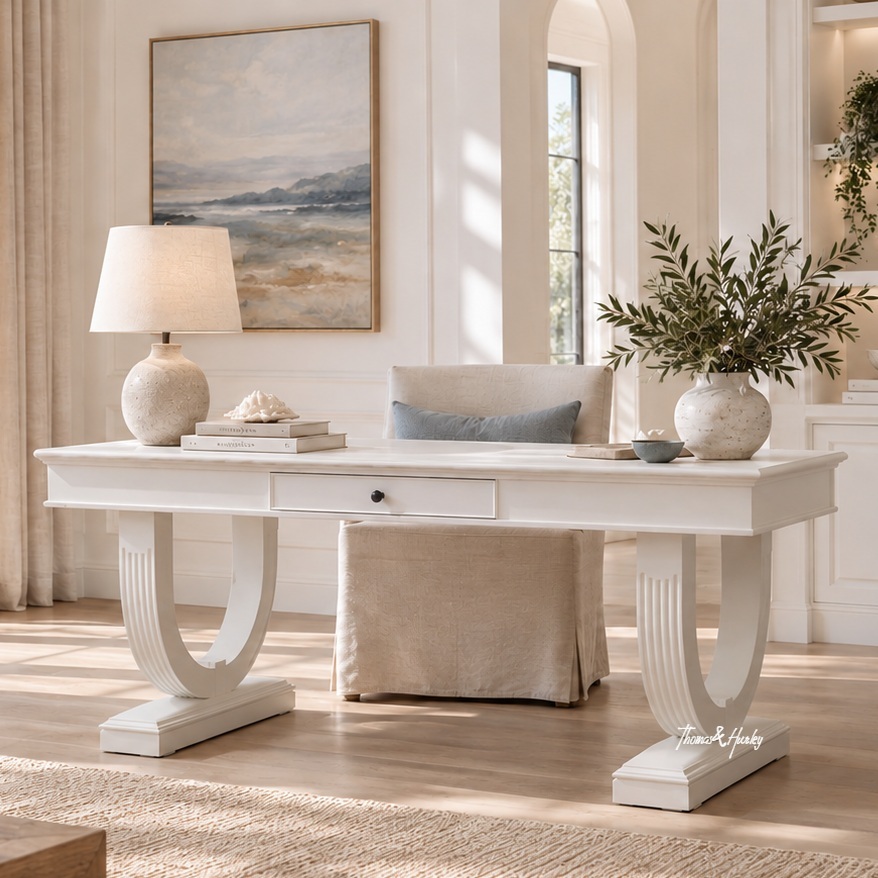
The Stonefield Writing Desk 160cm captures this idea beautifully.
With its pale finish and architectural pedestal form, it has enough presence to establish a working zone without making the room feel like an office.
In the reference interior, it sits within an expansive living space framed by tall windows, soft upholstery, natural textures and coastal views. Nothing around it suggests a conventional workspace.
That is precisely why it works.
The desk becomes another piece within the room's overall composition.
A table lamp, ceramic vessel, books and an upholstered chair are enough to establish its function. When the working day finishes, a laptop or papers can be removed and the desk returns to being part of the architecture of the room.
For Hamptons style interiors, contemporary-classic homes and relaxed coastal spaces, this can be far more sympathetic than introducing overtly commercial office furniture.
The room remains a living room first.
It simply happens to contain somewhere beautiful to work.
Do You Really Need a Dedicated Home Office?
For some households, certainly.
For many others, perhaps not.
The assumption that working from home requires a completely separate room can limit the way we think about existing spaces. A formal living room used only occasionally, a generous bedroom corner or an underutilised area beside a window may already offer everything needed for a comfortable workspace.
The key is choosing furniture that can participate in the room beyond working hours.
This is where designer writing desks have an advantage.
A desk positioned behind a sofa can act almost like a console. A writing table near a window can become an architectural focal point. A desk in a bedroom may hold books, flowers and a lamp when it is not being used for work.
Instead of creating an office inside the room, the aim is to integrate work into the interior.
It is a subtle distinction, but an important one.
The Reagan Campaign Desk: A Workspace That Disappears
If the Stonefield celebrates the writing desk as a permanent feature, the Reagan Oak Campaign Convertible Writing Desk explores almost the opposite idea.
Its workspace can effectively disappear.
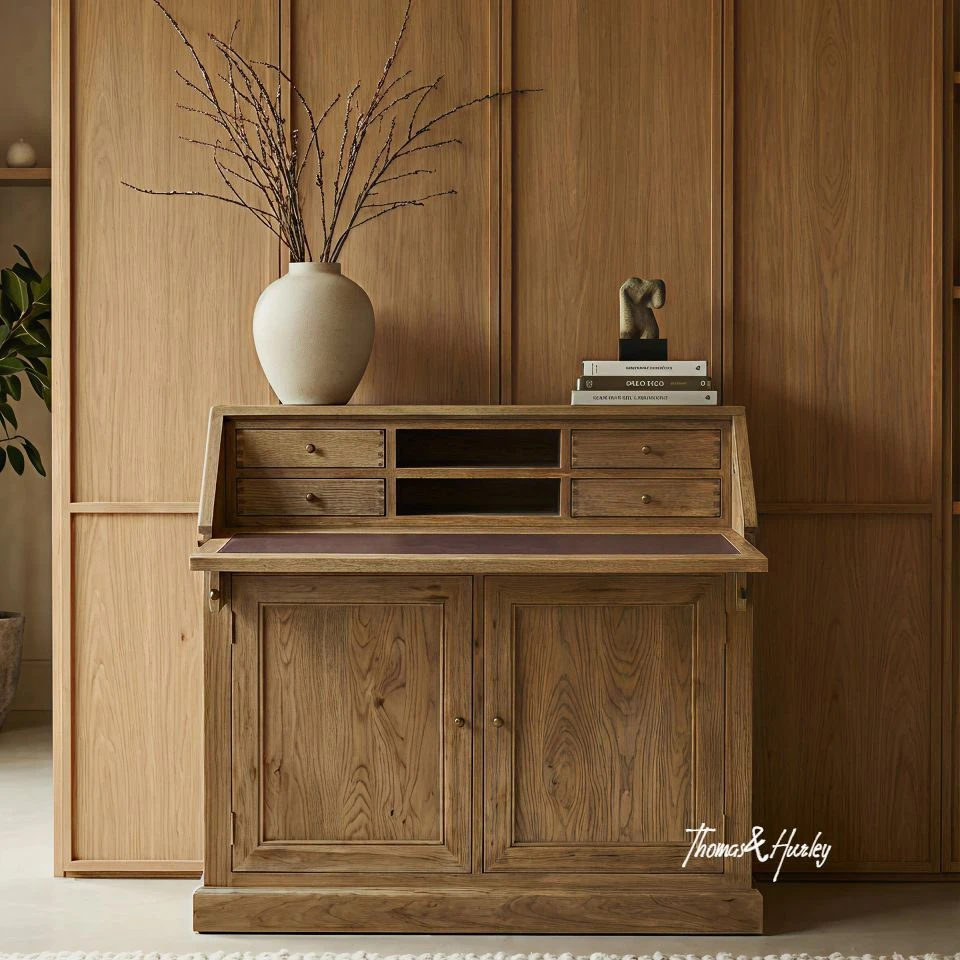
Closed, the Reagan reads as a handsome oak cabinet. Its drawers, open compartments and lower cupboards provide the visual language of storage furniture rather than a conventional desk.
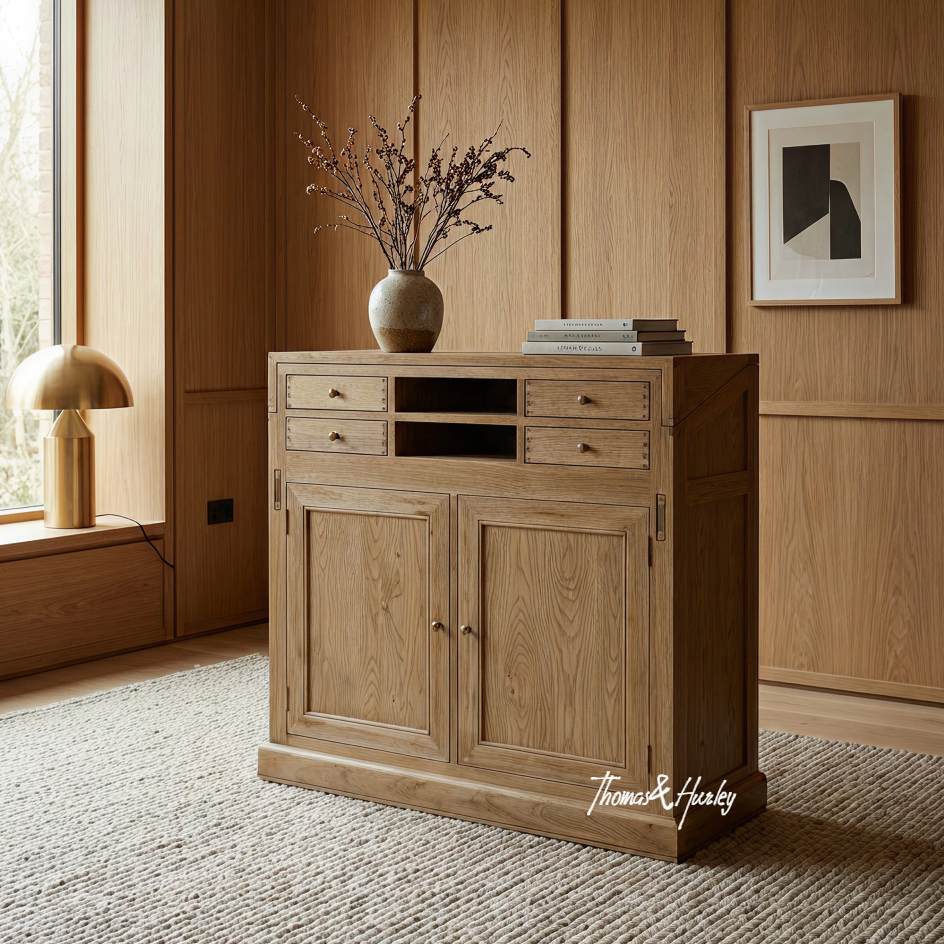
Open the front, however, and a generous writing surface is revealed.
That transformation makes the Reagan particularly interesting for rooms where a permanent desk might not be desirable.
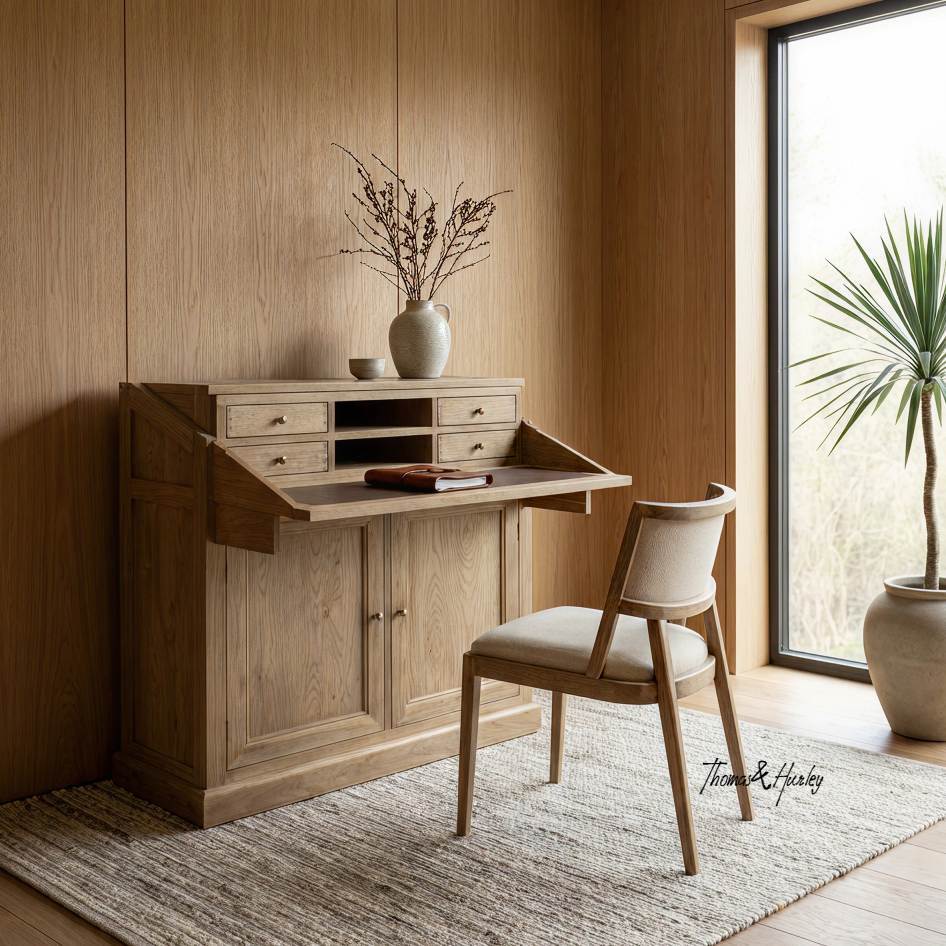
A living room can contain a functional workspace without looking like one.
A bedroom can provide somewhere to work or write without sacrificing its sense of calm.
A guest room can operate as an occasional office while remaining welcoming when visitors arrive.
Even a hallway, library or open-plan living area can potentially accommodate a discreet working zone.
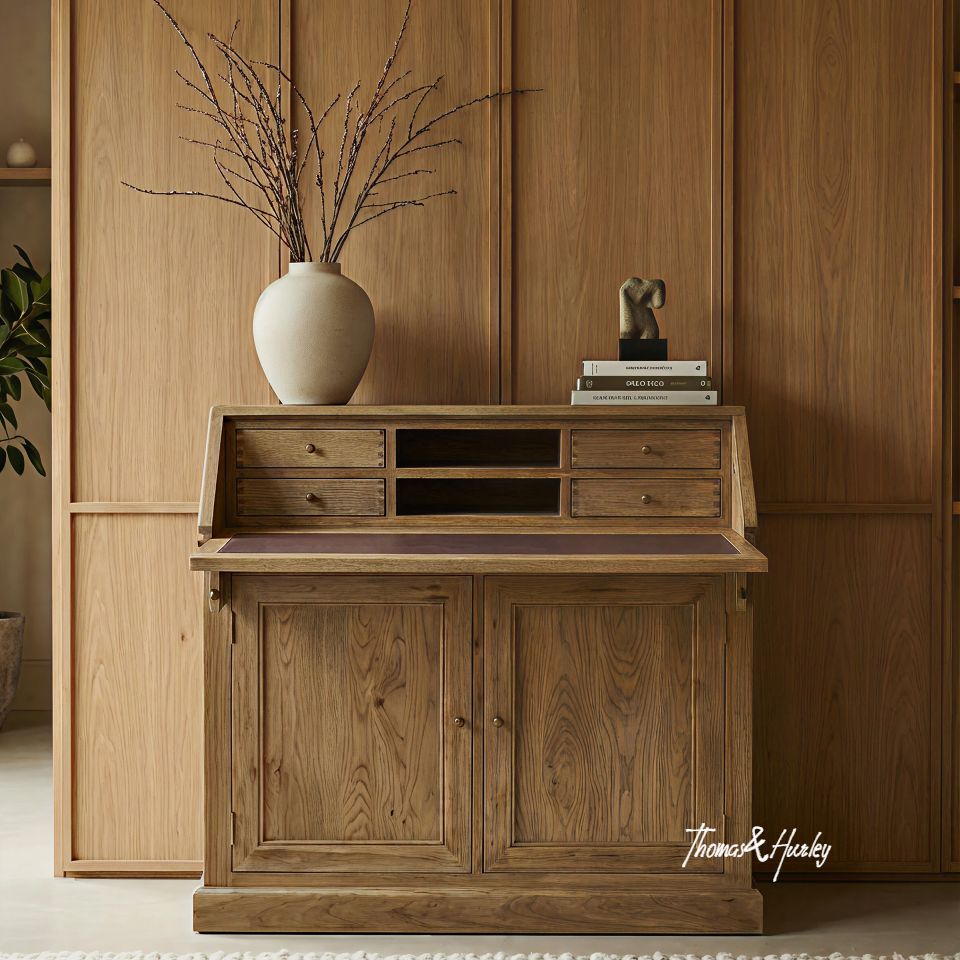
When the work is finished, the surface closes away again.
The architecture of the room returns.
Why Convertible Furniture Feels Relevant Again
Convertible furniture has existed for centuries, but its underlying idea feels remarkably contemporary.
Our homes are increasingly expected to perform several roles simultaneously.
The living room may need to accommodate entertaining, relaxation and occasional work. Dining areas may become places for study or creative projects between meals. Bedrooms often need a small workspace without feeling dominated by office furniture.
The answer does not always need to be more furniture.
Sometimes it is furniture that does more.
A convertible writing desk such as the Reagan allows one footprint to perform several functions. Storage, display and workspace coexist within the same piece.
That has obvious practical advantages, but there is also an aesthetic benefit.
Rather than filling the room with specialised furniture for every activity, adaptable pieces allow interiors to remain calmer.
This is especially valuable within warm minimalist interiors, where every piece needs to justify the space it occupies.
Campaign Furniture and the Beauty of Practical Design
The campaign influence of the Reagan is particularly appropriate.
Historically, campaign furniture was associated with portability and practicality. Furniture needed to perform its function efficiently while remaining sufficiently robust and elegant for domestic life.
That balance between refinement and usefulness remains part of its appeal.
In a contemporary interpretation, portability may be less important than adaptability, but the philosophy is similar.
Furniture should work hard without appearing utilitarian.
The Reagan's oak construction and restrained detailing allow it to sit naturally within contemporary rooms dominated by timber, linen and stone. Open, its numerous compartments provide organisation around the writing surface. Closed, that functional complexity becomes visually quiet.
It is a good example of furniture design solving a practical problem through form rather than technology.
There is no need for a complicated home-office system.
The furniture itself transforms.
Working in the Living Room
One of the most interesting ideas within these images is the possibility of placing the desk directly within the living room.
Traditionally, we might have attempted to hide work completely from areas associated with relaxation. Yet a beautiful writing desk can enrich a living room rather than compromise it.
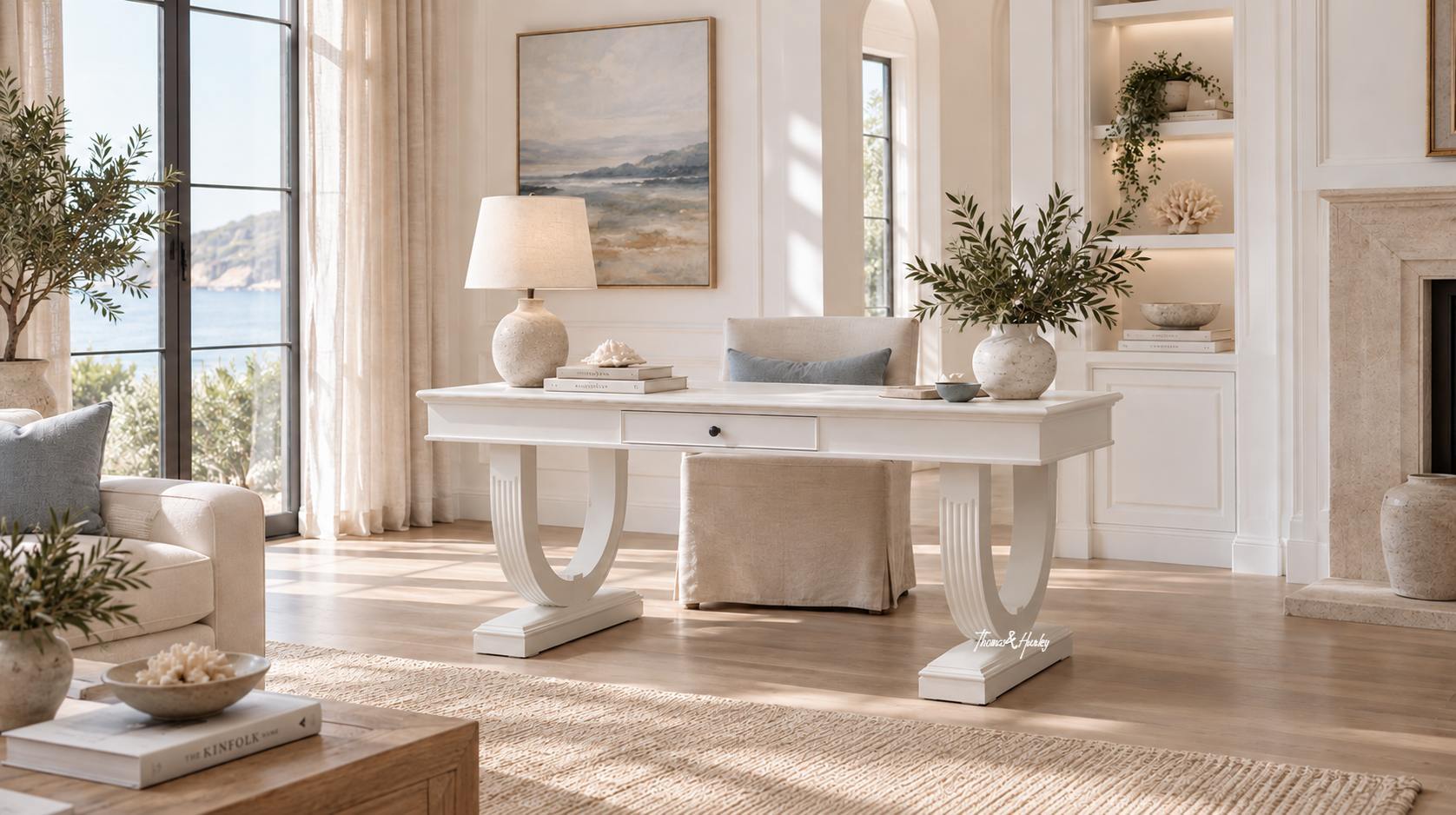
The distinction comes down to styling and proportion.
Avoid surrounding the desk with conventional office paraphernalia. Instead, treat it as you would any other piece of living-room furniture.
A ceramic lamp can replace a task light.
A dining or occasional chair can feel softer than an office chair.
A small artwork above the desk connects the composition to the rest of the room.
Books, a sculptural bowl or greenery can replace purely functional accessories.
The result is a workspace that feels residential.
With the Stonefield Writing Desk, this approach is particularly effective. Its form is substantial enough to hold its own within a large room, while its light finish allows it to integrate with architectural joinery, warm white walls and neutral upholstery.
Rather than creating a visual interruption, the desk becomes part of the rhythm of the interior.
The Bedroom Desk
Bedrooms offer another natural location for a writing desk.
A desk beside a window can create a quiet place for correspondence, reading or occasional work without requiring another room.
Here, the visual softness of the furniture becomes especially important.
A highly technical desk can quickly make a bedroom feel like an office. A classic writing desk, however, can sit comfortably alongside bedside tables, upholstered furniture and chests of drawers.
The chair also matters.
An upholstered dining or occasional chair is often sufficient for shorter periods of desk use and allows the composition to remain consistent with the bedroom.
A lamp, framed artwork and perhaps a small vessel can complete the arrangement.
When work is not taking place, it simply looks like a beautifully considered corner of the room.
When a Cabinet Becomes an Office
The Reagan offers another possibility for the bedroom.
Because it closes, the visual language of work can disappear entirely.
This can be particularly valuable in spaces intended for rest.
Documents, notebooks and everyday working materials can be organised within the desk, the writing surface can be closed, and the room no longer presents itself as somewhere work is waiting to be done.
The same principle works in living rooms.
A conventional desk can remain visually active even when nobody is sitting at it. Screens, cables and papers have a way of announcing themselves.
Convertible furniture offers an architectural solution.
Close the piece, and the room changes with it.
The Churchill Drop Leaf Table: Another Kind of Flexibility
Adaptable furniture does not end with desks.
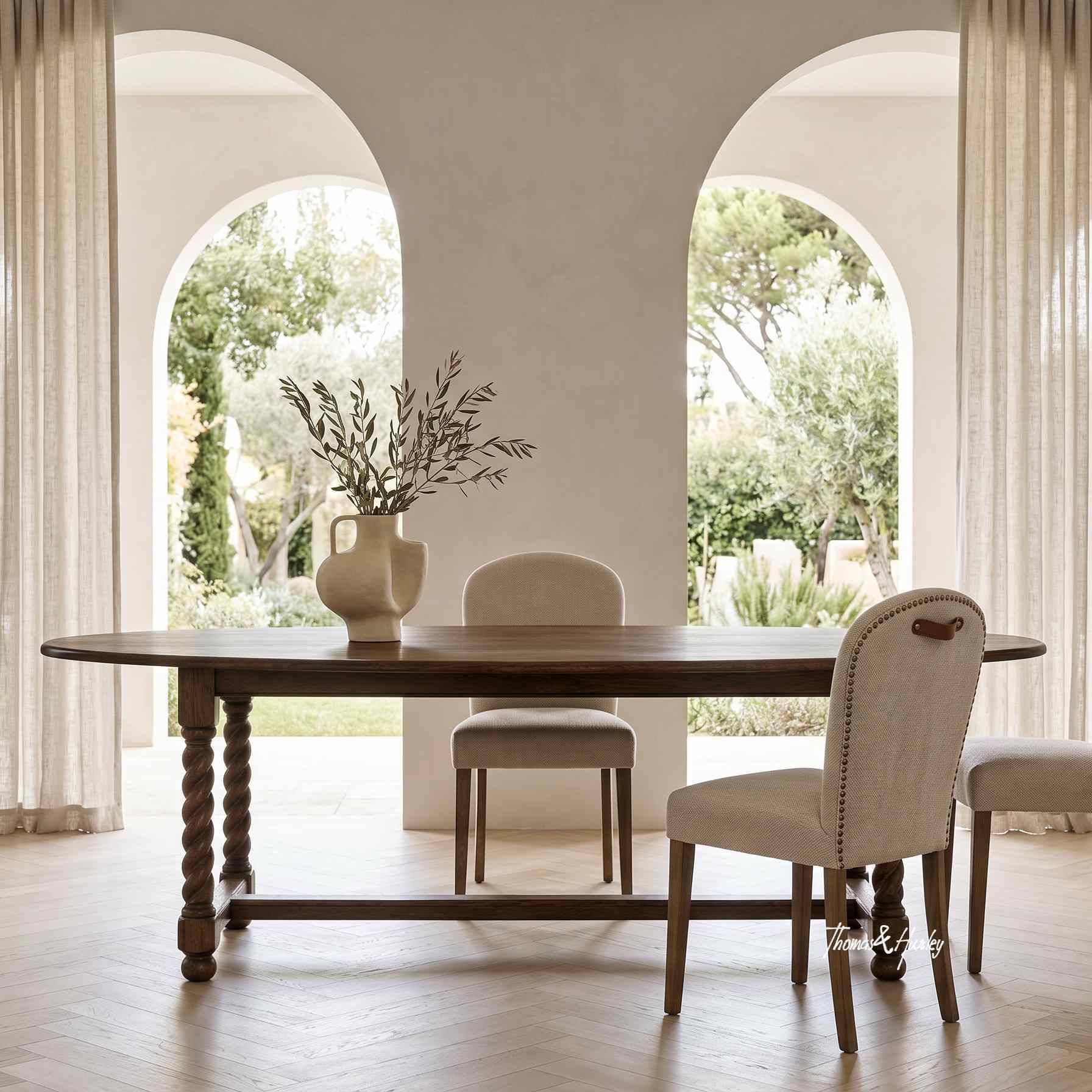
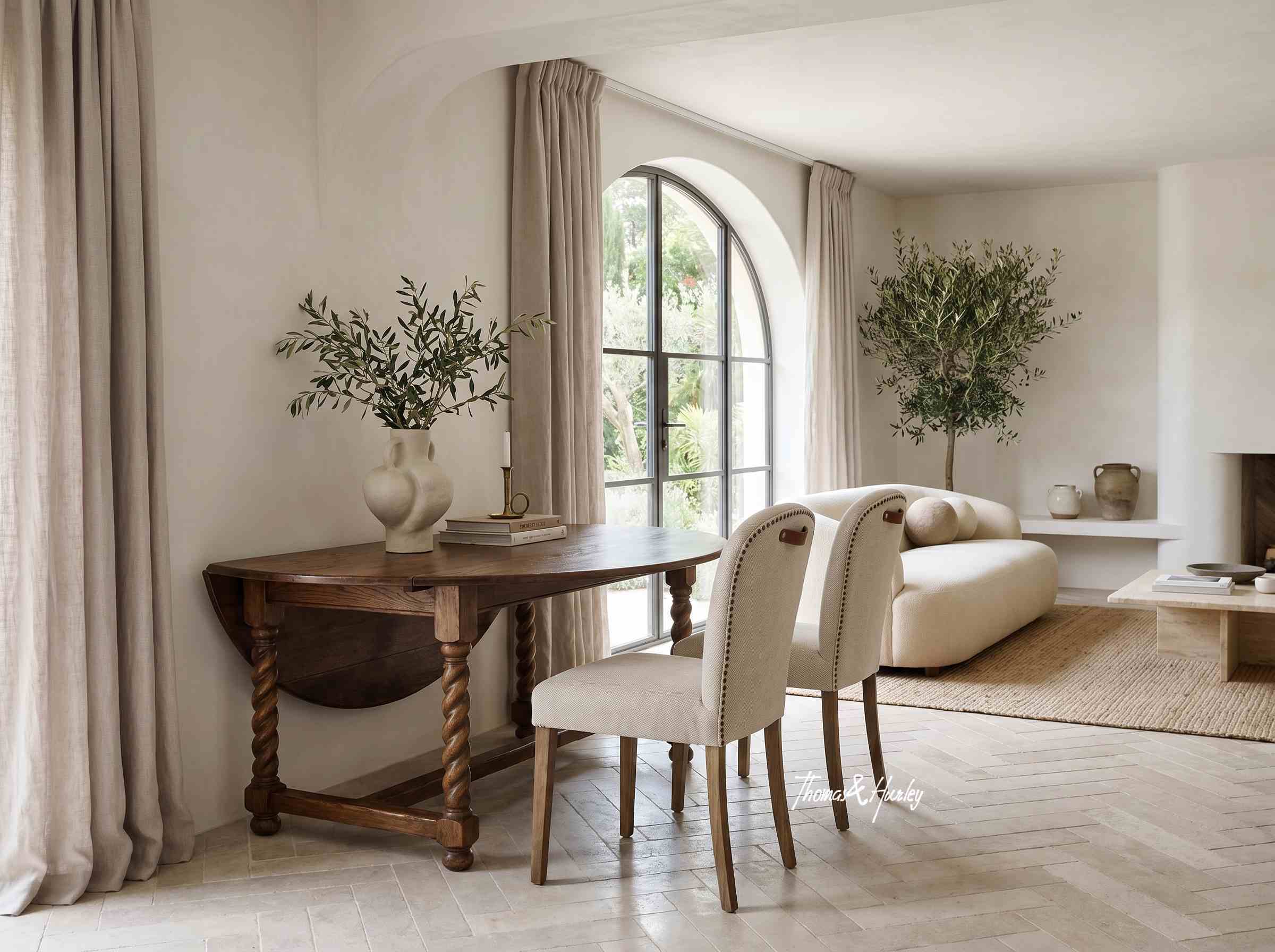
The Churchill Barley Twist Oval Drop Leaf Extending Table approaches flexibility through one of furniture design's most enduring mechanisms: the drop leaf.
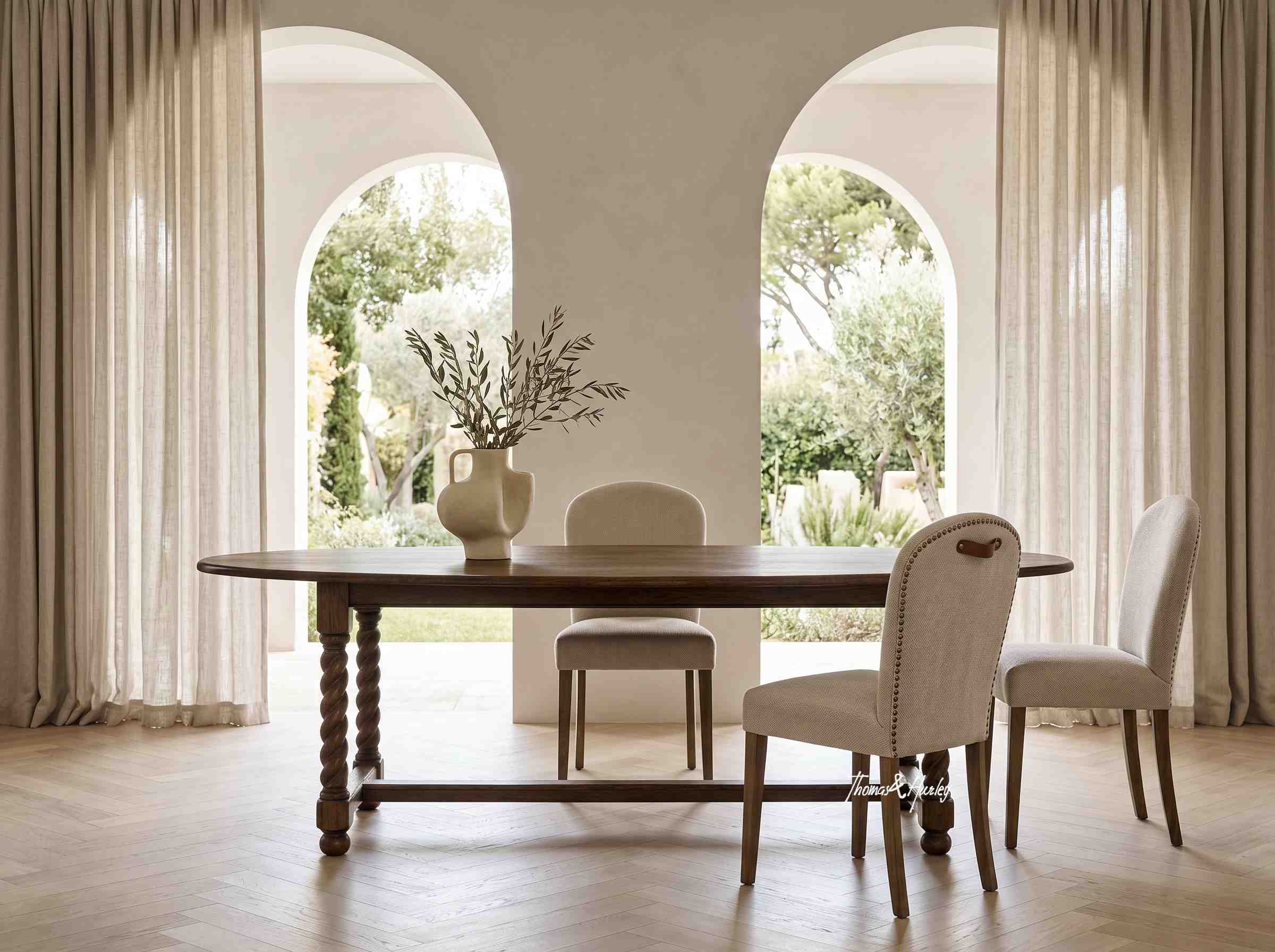
With its leaves lowered, the table occupies a relatively compact footprint. Raise them when additional surface is required and its function expands.
This simple idea makes the Churchill remarkably versatile.
It might sit against a wall or beneath an artwork much of the time, then become a table for dining when required. In a generous living room it could provide an occasional work surface. In an apartment or smaller dining zone, it allows the room to remain open between meals.
The beauty lies in the contrast between practicality and detail.
Its barley twist legs bring a strong decorative character that connects the table to traditional English and European furniture, while its adaptable top makes it relevant to contemporary living.
Again, useful furniture does not have to look purely functional.
A Dining Table That Does Not Always Need to Be a Dining Table
The way we use tables has become increasingly fluid.
A dining table might host dinner in the evening, paperwork in the morning and flowers for most of the week.
With a drop-leaf design, that flexibility becomes physical.
The Churchill can change scale according to what the room requires.
This is particularly useful in open-plan interiors where maintaining circulation and visual space can be as important as providing maximum seating capacity.
Rather than permanently dedicating a large footprint to dining, the room can expand and contract.
That concept connects beautifully with the Reagan Campaign Desk.
Although the two pieces look entirely different, they share the same underlying philosophy:
give the room more possibilities without permanently demanding more space.
Furniture for the Spaces Between Rooms
Some of the best places for a desk are not rooms at all.
A wide hallway.
A landing.
The area behind a sofa.
An alcove beside a fireplace.
A section of joinery between the kitchen and living area.
These spaces often remain decorative because they are not large enough to accommodate an entire conventional furniture setting.
But they may be perfect for a writing desk.
The Reagan, in particular, offers the possibility of turning an otherwise passive wall into a small working zone.
Likewise, a writing desk such as the Stonefield can define an area within a much larger open-plan room without requiring walls or architectural division.
Furniture becomes the architecture.
Choosing Between a Writing Desk and Convertible Desk
The decision ultimately depends on how frequently the workspace will be used.
For regular working, the permanence and generous surface of the Stonefield Writing Desk may be preferable. It establishes a clear place to sit and work, while remaining elegant enough to live comfortably within the home's principal rooms.
For occasional working or rooms where the workspace needs to disappear, the Reagan Oak Campaign Convertible Writing Desk offers another solution. Its ability to transition from cabinet to writing desk makes it particularly suited to multi-purpose rooms.
Neither approach is inherently better.
They solve different problems.
The important consideration is how the room needs to behave throughout the day.
Designing a Home Around Real Life
The most successful interiors are not simply beautiful when photographed.
They work when people actually live in them.
A living room should accommodate conversation, reading and perhaps an hour of work in the morning.
A bedroom can provide somewhere quiet to write.
A dining space should be able to welcome additional people when required without necessarily surrendering half the room to a large table every day.
This is where adaptable furniture becomes so valuable.
The Stonefield Writing Desk, Reagan Oak Campaign Convertible Writing Desk and Churchill Barley Twist Oval Drop Leaf Extending Table each offer a different interpretation of flexibility.
One provides a permanent and elegant workspace.
One conceals the workspace when it is no longer needed.
One changes its physical footprint according to the occasion.
None asks the interior to compromise its character.
A More Considered Kind of Practicality
There is sometimes an assumption that practical furniture must look practical.
But historically, some of the most ingenious furniture designs were also among the most beautiful.
Desks concealed compartments. Tables folded and extended. Cabinets transformed. Furniture was expected to adapt because rooms themselves often performed several functions.
Perhaps contemporary interiors are rediscovering something earlier generations already understood.
A room does not have to be dedicated to a single activity.
And furniture does not have to perform only one role.
For Thomas & Hurley, these pieces offer a way to create homes that remain elegant while responding naturally to everyday life.
A desk can belong in the living room.
An office can disappear behind cabinet doors.
A compact table can become somewhere to gather.
Sometimes the most luxurious furniture is not simply the piece that looks beautiful in the room.
It is the piece that allows the room to become something more.